
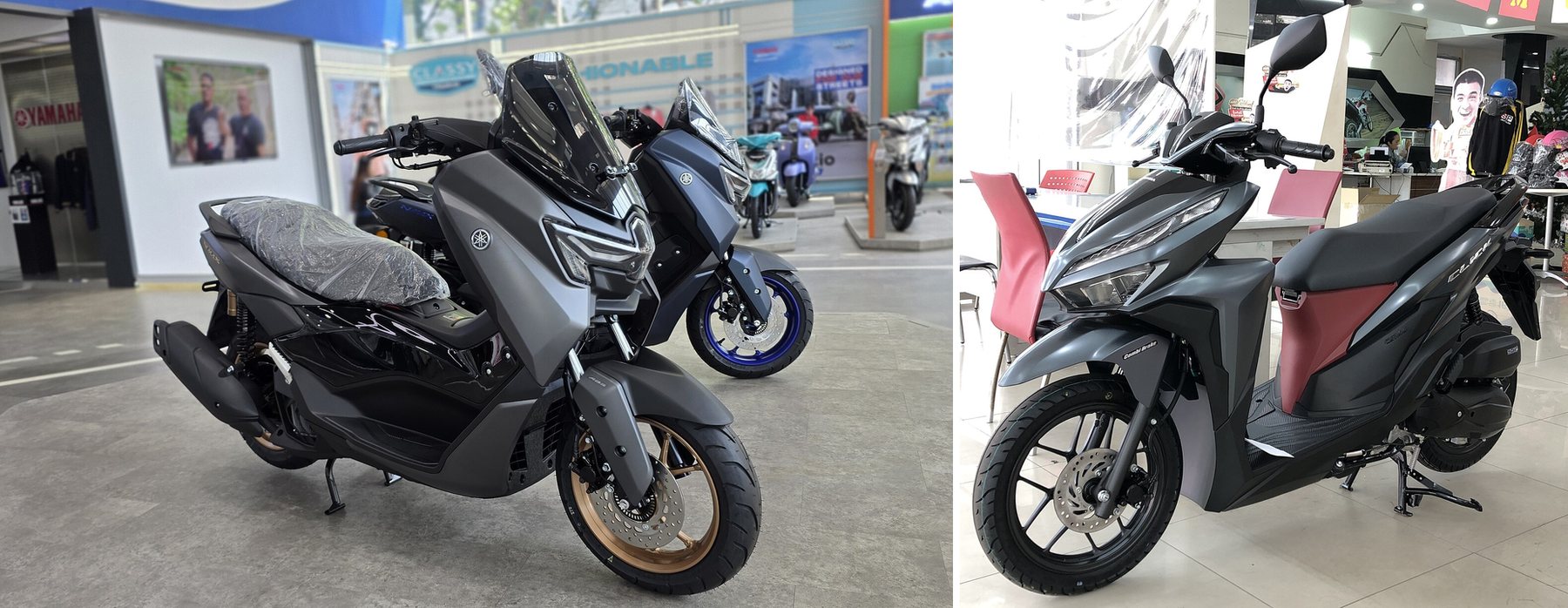
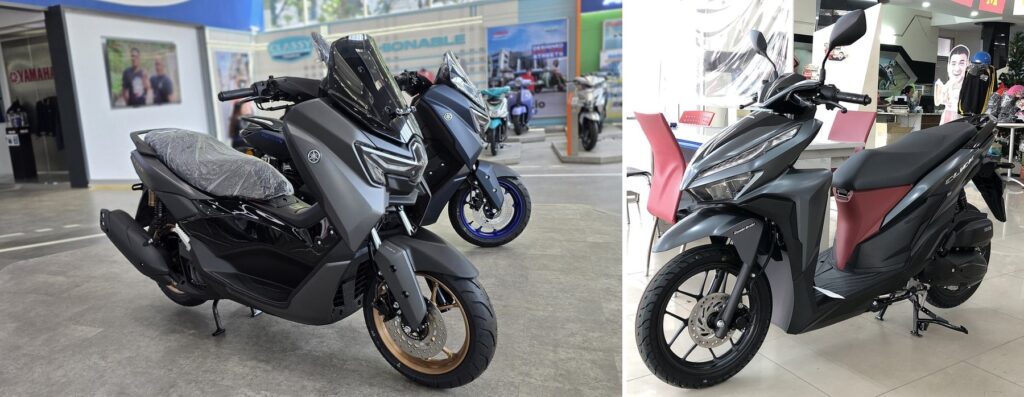
The Honda Click 160 and Yamaha NMAX 155 both sit in our premium tier, but at opposite ends of it — the Click 160 is the most affordable way into premium features, while the NMAX 155 costs a bit more for a larger, sportier machine. Both get cross-shopped by renters who want something more capable than a basic 125cc scooter without stepping all the way up to a full maxi-scooter like the PCX 160 or ADV 160. This guide compares them using official manufacturer specifications to show exactly what that price difference buys, and corrects a few assumptions that do not hold up once you look at the real numbers.
Before you choose, check 2026 scooter prices in Thailand.
Ready to rent one? Chang Thai delivers free on rentals of 7+ days and never holds your passport. Yamaha NMAX 155 ABS rental in Phuket (฿450/day, ฿6,700/month) · Honda Click 160 rental in Phuket (฿5,000/month).
In This Guide
- Full Side-by-Side Specifications
- Engine and Power
- Weight and Handling
- Seat Height: Not What You Might Expect
- Storage Capacity
- Fuel Tank and Range
- ABS: Front-Only vs Front-and-Rear
- A Note on the Click 160's Thailand Market Variant
- Suspension and Ride Comfort
- Real Riding Scenarios
- Maintenance Considerations
- Fleet Colors and Design
- Value Summary: Baht Per Feature
- Price at Chang Thai
- Why We Carry Both
- Who Should Choose Which?
- FAQ
Full Side-by-Side Specifications
| Specification | Honda Click 160 | Yamaha NMAX 155 |
|---|---|---|
| Engine | 156.93cc, liquid-cooled, eSP+ | 155cc, liquid-cooled, VVA |
| Max power | Approx. 15 hp | Approx. 15 hp @ 8,000 rpm |
| Max torque | Approx. 13.8 Nm | Approx. 13.9 Nm @ 6,500 rpm |
| Curb weight | 116 kg | 127 kg |
| Seat height | 778 mm | 765 mm |
| Ground clearance | 138 mm | Not officially published |
| Fuel tank | 5.5 L (Thailand ABS variant) | 7.1 L |
| Under-seat storage | 18 L (fleet spec) | 25 L (fleet spec) |
| Braking | Front and rear disc, ABS on front wheel | Front and rear disc, ABS |
| Daily rate at Chang Thai (low/high) | ฿400 / ฿450 | ฿450 / ฿500 |
Sources: specifications referenced from Thai Honda's official Click 160 product page and Yamaha Motor's official NMAX 155 product data, cross-checked against our own fleet units.
Engine and Power
Both bikes make almost identical power, roughly 15 hp, from very similarly sized engines using different technology to get there — Honda's eSP+ efficiency-focused tuning on the Click 160, and Yamaha's VVA variable valve timing on the NMAX 155. Neither has a meaningful straight-line speed advantage over the other. The practical difference in day-to-day riding comes down to how each engine is packaged into the rest of the bike, not the number on the spec sheet.
Weight and Handling
The Click 160 is the lightest bike in our entire premium tier at 116kg, a full 11 kilograms lighter than the NMAX 155's 127kg. That weight advantage makes the Click 160 noticeably easier to maneuver at low speed, park in tight spaces, and hold up at a stop, which matters more than raw power in dense areas like Patong or Phuket Town. The NMAX 155's extra weight buys a larger, more substantial-feeling machine at speed, but the Click 160 has a genuine agility advantage that is easy to underestimate on paper.
Seat Height: Not What You Might Expect
This is worth correcting directly: the Click 160 is often assumed to be the lower, more accessible option, but its official seat height of 778mm is actually taller than the NMAX 155's 765mm — closer to the Honda ADV 160's 780mm than to a typical low-seat commuter scooter. If seat height and ease of flat-footing at a stop is your priority, the NMAX 155 is the better fit between these two, not the Click 160. Riders who specifically need the lowest possible seat height in our fleet should look at the Honda Scoopy 125 or Click 125i instead — see our rider guide for the full picture.
Storage Capacity
The NMAX 155 wins clearly here, with 25 liters of under-seat storage against the Click 160's 18 liters. Both fit a single full-face helmet, but the NMAX has meaningfully more room left over for a bag, light jacket, or shopping. If storage capacity matters more to your trip than the Click 160's weight advantage, the NMAX 155 is the better choice.
Fuel Tank and Range
The Click 160's 5.5 liter tank is notably smaller than the NMAX 155's 7.1 liters, meaning more frequent fuel stops on longer touring days, even though the Click 160's lighter weight partially offsets this with slightly better efficiency per liter. For short, local riding around one area of the island, the difference barely registers. For longer routes further from fuel stations, the NMAX 155's larger tank is a genuine practical advantage.
ABS: Front-Only vs Front-and-Rear
Both bikes have ABS, but not to the same degree: the Click 160's ABS system operates on the front wheel, while the NMAX 155 has ABS covering both front and rear brakes. In practical terms, front-wheel ABS addresses the most common cause of a low-speed skid — locking the front wheel under hard braking — but full front-and-rear coverage on the NMAX 155 gives a slightly larger safety margin on wet or loose surfaces, particularly under harder braking at higher speed.
A Note on the Click 160's Thailand Market Variant
Worth knowing if you research the Click 160 online before your trip: some markets, including the Philippines, sell a Click 160 "Standard" trim without ABS, using a front disc and rear drum brake instead. The version sold and rented in Thailand, including every unit in our fleet, is the ABS variant with front and rear disc brakes and ABS on the front wheel. If you read a review or forum post describing the Click 160 without ABS, it is almost certainly describing a different regional trim, not the bike you will actually be riding here.
Suspension and Ride Comfort
Both bikes use a fairly conventional telescopic front fork and twin rear shock setup typical of this scooter class, tuned firmer than a basic commuter model on both bikes. The NMAX 155's slightly heavier chassis and sportier geometry give it a more planted, settled feeling over rougher patches of road, while the Click 160's lighter weight makes it feel quicker to respond to steering input but slightly more affected by sharp bumps and expansion joints. Neither is uncomfortable for a full day of riding, but the difference is noticeable back to back on the same stretch of road.
Real Riding Scenarios
Weaving through Phuket Town's narrow old town streets and parking in tight spots, the Click 160's lighter weight and smaller footprint make it the easier bike to live with day to day. On a longer coastal touring day, such as the routes in our two-up touring guide, the NMAX 155's larger tank and extra storage start to matter more, even though that guide focuses on the PCX 160 specifically. For a rider splitting time between a home base in town and day trips further out, the choice often comes down to which use case dominates your specific itinerary.
Maintenance Considerations
Both bikes in our fleet follow manufacturer-recommended service intervals rather than a generic rental-shop schedule. The Click 160's smaller fuel tank means renters on longer routes should plan fuel stops slightly more deliberately, though this is a planning consideration rather than a maintenance one. The NMAX 155's VVA system depends on clean oil flow to switch valve timing correctly, so we service those units on a slightly tighter oil change interval than the Click 160's simpler eSP+ engine typically requires.
Price at Chang Thai
| Honda Click 160 | Yamaha NMAX 155 | |
|---|---|---|
| Daily (low/high season) | ฿400 / ฿450 | ฿450 / ฿500 |
| Weekly (low/high season) | ฿2,100 / ฿2,450 | ฿2,450 / ฿2,800 |
| Monthly (low/high season) | ฿5,000 / ฿6,000 | ฿6,700 / ฿7,500 |
The Click 160 costs ฿50 less per day than the NMAX 155 at every rental period, making it the most affordable way to get ABS braking and a "premium" ride feel in our fleet. See our pricing page for current rates.
Why We Carry Both
It might seem redundant to stock two bikes this close in price and power, but they solve different problems well enough that we consistently see demand for both. Renters who tried the Click 160 first and later compared it to the NMAX 155 usually describe the difference as "lighter but smaller" rather than one being simply better than the other, which is exactly the trade-off the specifications above show. Keeping both in the fleet means we can match the bike to the trip rather than pushing everyone toward a single "premium" default.
Who Should Choose Which?
Choose the Honda Click 160 if you want the cheapest bike in our fleet with ABS, plan mostly short, local riding, and value light, easy handling over storage or tank range. Choose the Yamaha NMAX 155 if you want more under-seat storage, a lower seat height, a larger fuel tank for longer days, or the added safety margin of full front-and-rear ABS. For the complete picture including the PCX 160 and ADV 160, see our Best Scooter Phuket 2026 guide.
Fleet Colors and Design
Our Click 160 units come in grey-black, black, and red-black, styled with sharper, more angular lines than the outgoing Click generation, while the NMAX 155 fleet runs in matte blue, white, and black with Yamaha's sportier, more rounded design language. Both bikes feature LED lighting throughout, though the Click 160's headlight signature reads a touch more aggressive, in keeping with Honda's repositioning of the newer Click generation as a genuinely sporty model rather than a basic commuter.
Value Summary: Baht Per Feature
Breaking the ฿50 daily gap down by feature, the NMAX 155 adds roughly 7 extra liters of under-seat storage, 1.6 extra liters of fuel tank capacity, and rear-wheel ABS coverage for that difference. Whether that combination is worth ฿50 a day to you depends entirely on how you plan to use the bike — for short, local riding, none of those three advantages come into play often enough to matter, but for full-day touring or anyone prioritizing safety margin, they add up to a meaningful upgrade for a modest price increase.
Where to Rent
Both models are available at all five Chang Thai branches: Phuket Airport, Mai Khao, Bang Tao, Chalong, and Phuket Town.
FAQ
Is the Honda Click 160 actually lower to the ground than the Yamaha NMAX 155?
No — its official seat height of 778mm is taller than the NMAX 155's 765mm. The Click 160 is lighter, not lower.
Which bike has better ABS coverage?
The Yamaha NMAX 155, with ABS on both front and rear brakes, versus front-only ABS on the Click 160.
Is the Click 160 worth choosing over the NMAX 155 just to save money?
If your riding is mostly short and local, yes — the ฿50 per day saved buys a lighter, easier-to-park bike with only modest trade-offs in storage and tank range.
Which bike is better for a full day of touring?
The NMAX 155, thanks to its larger fuel tank and greater storage capacity for a full day away from your accommodation.
Is the Click 160 too small or underpowered for an adult rider?
No — despite being the lightest bike in our premium tier, it produces essentially the same horsepower as the NMAX 155 and comfortably carries an adult rider or two-up for shorter trips.
Does the Click 160's smaller fuel tank mean it is less fuel efficient?
The opposite, in fact — its lighter weight generally gives it slightly better fuel efficiency per liter. The smaller tank just means fewer total kilometers before a refill, not worse efficiency.
Related Reads
- Yamaha NMAX 155 Full Review and Price 2026
- Honda Click 160 Phuket Hill Test
- Premium Scooter Rental Phuket: Worth the Extra Baht?
- Which Scooter Fits You? A Rider-by-Rider Guide
Photo credits: “Yamaha NMAX Turbo 155 front side view in Indonesia” — Dedybudiman08, CC BY-SA 4.0, Wikimedia Commons · “2022 Honda Click 125” — Chanokchon, CC BY-SA 4.0, Wikimedia Commons