


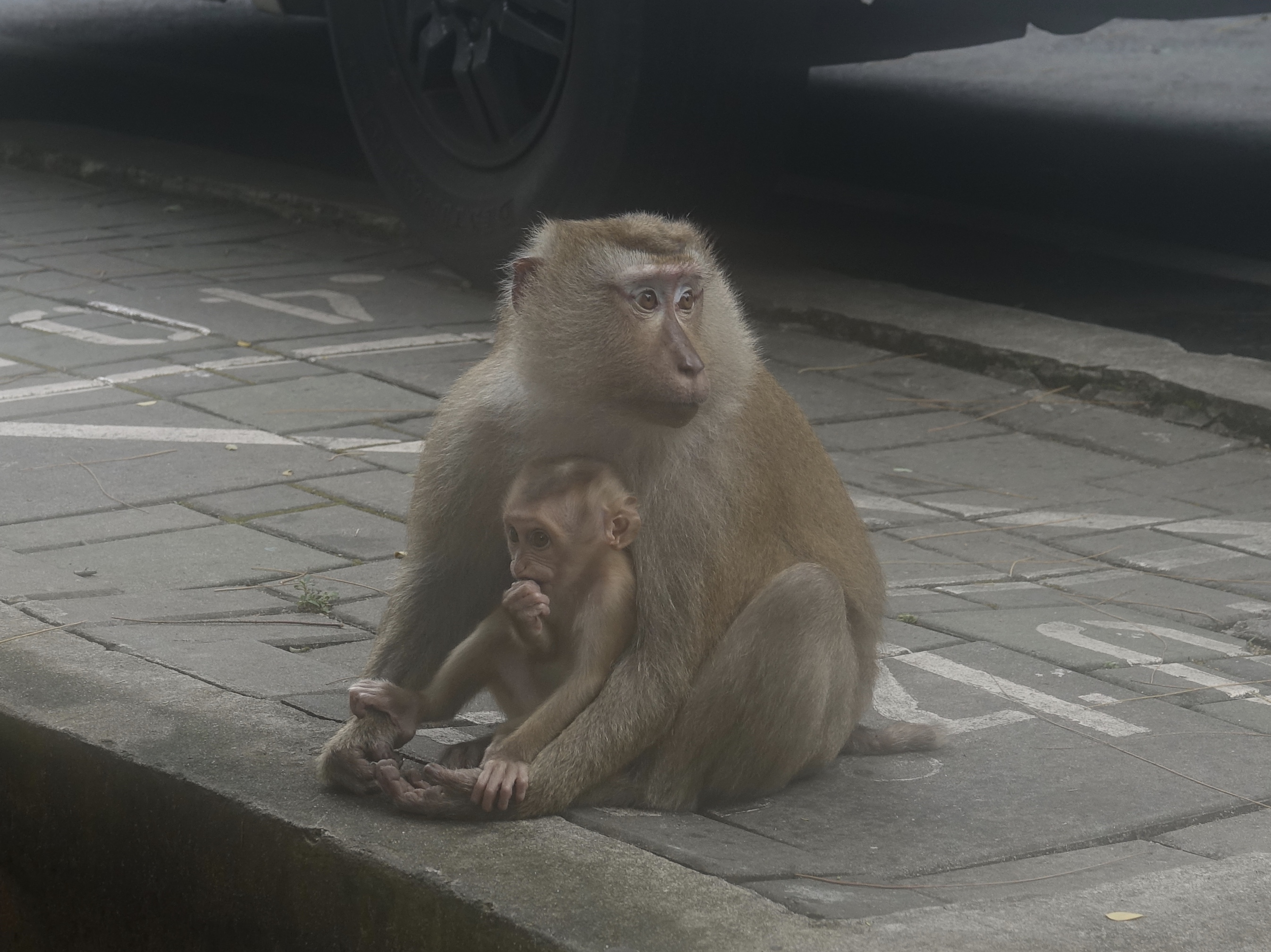
About 800 metres north of Phuket Provincial Hall, a steep, switchbacking road climbs the flank of Khao Toh Sae — a roughly 270-metre hill better known to visitors as Monkey Hill. It's the highest point overlooking Phuket Town, and its slopes are home to a large, genuinely wild troop of long-tailed macaques. It's a real, easy half-day stop if you're riding around Phuket Town — but it's worth going in with accurate expectations about both the hill and the monkeys, so here's what's actually there.
What Monkey Hill Actually Is
Khao Toh Sae sits in the Ratsada area on the northern edge of Phuket Town. It isn't a zoo, sanctuary, or fenced attraction — it's a public hillside with a paved access road, and the macaques living on it are fully wild and free-ranging, not captive animals kept for tourists. Partway up the road there's a small, colourful shrine dedicated to three local spirits (known locally as Chao Por To Sae), which is popular with Thai visitors, especially on Fridays, and busiest around Thai lottery draw days. Further up, past a series of pull-offs and viewpoints, the road reaches a summit area dominated by TV and radio broadcast towers, alongside a purpose-built viewing platform that gives a genuine panorama over Phuket Town and the hills beyond it.
The macaque population is generally estimated by local guides at somewhere in the low hundreds, living in several troops spread across the hillside rather than one single group. You'll typically see monkeys from early on the climb, with larger concentrations near the shrine and further up toward the summit road, where they're used to passing traffic and pedestrians.
Getting There by Scooter
From our Chalong branch, it's roughly 9–10 km into Phuket Town and then a short hop north to the base of the hill — figure on about 20–25 minutes by scooter once you factor in town traffic and the climb itself, longer at rush hour. From central Phuket Town it's only a few minutes: head out via Montri Road toward Narrison Road and Surin Road, then follow signs for Soi Toh Sae, which puts you directly at the base of the access road. The road itself is narrow and genuinely steep in places, with tight bends, so keep speeds low, stay alert for monkeys sitting or crossing on the tarmac, and give way to walkers and joggers — a lot of local residents use the hill for exercise, especially in the early morning and late afternoon.
Note that the road to the very top is closed to motor vehicles for a window in the late afternoon and evening so that people can walk or jog safely — if you're planning to ride all the way to the summit viewpoint, aim for late morning or early-to-mid afternoon rather than sunset, or be prepared to park partway up and finish the climb on foot.
Fees, Hours, and Facilities
Access to Monkey Hill is free — there's no ticket booth or entry fee. The road is generally open from around 7am to 10pm daily, though as noted above the upper stretch is closed to vehicles during set hours for pedestrian safety. Along the route you'll find:
- Paved pull-offs and parking areas at several points on the climb
- Basic public restrooms and concrete benches
- A small shrine with space to pay respects or make an offering
- Small local vendor stalls selling bananas, corn, and nuts
- A built viewing platform near the summit with a genuine city panorama
Don't expect a manicured tourist park — it's a working local hillside with a shrine and a view, which is a large part of its charm, but also why it pays to treat the monkeys as wildlife rather than a photo prop.
An Honest Note on Macaque Safety
This part matters, so we're not going to gloss over it: wild long-tailed macaques at popular Thai tourist sites have a documented history of biting and scratching visitors, and it happens for a specific, understandable reason. Monkeys at heavily visited spots — Monkey Beach on Phi Phi and sites around Krabi and Phuket among them — have become habituated to associating humans with food, largely from years of tourists hand-feeding them or waving snacks around for photos and videos. When a monkey expects food and doesn't get it, or feels cornered while trying to get it, that's when bites and scratches happen. Animal welfare groups have specifically warned that these encounters are far less predictable than they look on social media, and incidents tend to spike during busy holiday periods when crowds and food are both more common. None of this means Monkey Hill is dangerous to visit sensibly — but it does mean the "cute wild monkeys" framing you'll see in a lot of older travel write-ups leaves out real risk.
A few practical habits make a real difference:
- Don't carry visible food or crinkly plastic bags. Macaques recognise both instantly, and a rustling bag is often what draws a monkey toward you in the first place.
- Avoid prolonged, direct eye contact. To a macaque, a sustained stare — or bared teeth, even a big smile — reads as a threat display, not friendliness.
- Keep your distance, especially from mothers with babies. Never walk between two monkeys, or between a mother and her infant, and never block an animal's escape route.
- Secure loose items before you get close. Sunglasses, phones, camera straps, dangling jewellery, and even water bottles are classic targets — macaques are quick and know exactly how to grab and run.
- If you buy bananas from a vendor stall, place or toss the food rather than holding it out. Letting a monkey take food directly from your hand is one of the more common ways people get nipped.
- If a monkey bares its teeth, screeches, or lunges, back away slowly. Don't run, and don't shout — sudden movement and noise usually escalate the situation rather than defusing it.
If you are bitten or scratched, treat it as a genuine medical event, not just a story for later. Wash the wound immediately and thoroughly with soap and running water for a good ten to fifteen minutes, then get it looked at promptly — ideally the same day — at a clinic or hospital rather than waiting. Monkey bites are a real and fairly common reason travellers in Thailand seek treatment, and while the risk from any single encounter is low, rabies and, more rarely, macaque-specific viral infections are both reasons doctors take these wounds seriously and may recommend a vaccination course. This isn't meant to scare you off the hill — it's meant to make sure a fun stop stays that way.
Tips for a Better Visit
- Go in the late morning or mid-afternoon, when the summit road is open to vehicles and the light is good for photos without the harshest midday sun.
- Wear closed shoes — the road is steep and can be slippery after rain, and you'll want good footing if you decide to walk any stretch.
- Bring water; there's shade in patches, but the climb is exposed in places and Phuket's heat is no joke.
- Use a zoom lens or your phone's zoom rather than crouching close for a selfie with the monkeys.
- Budget 30–45 minutes if you're just doing the drive-up-and-view loop, longer if you want to stop at the shrine or linger at the viewpoint.
Monkey Hill works best as a short, specific stop rather than a full day out — pair it with a longer loop around Phuket Town, or fold it into a ride up toward the north of the island. Having your own scooter makes this kind of stop far easier than trying to arrange a taxi up a steep, winding side road. You can rent one from any of our branches — Chalong, Bangtao, Phuket Old Town, Mai Khao, or right at Phuket Airport — and we're reachable on WhatsApp at +66 93 687 1999 if you need directions or advice on the ride up. Check current bikes and rates on our Phuket scooter rental page before you head out.