
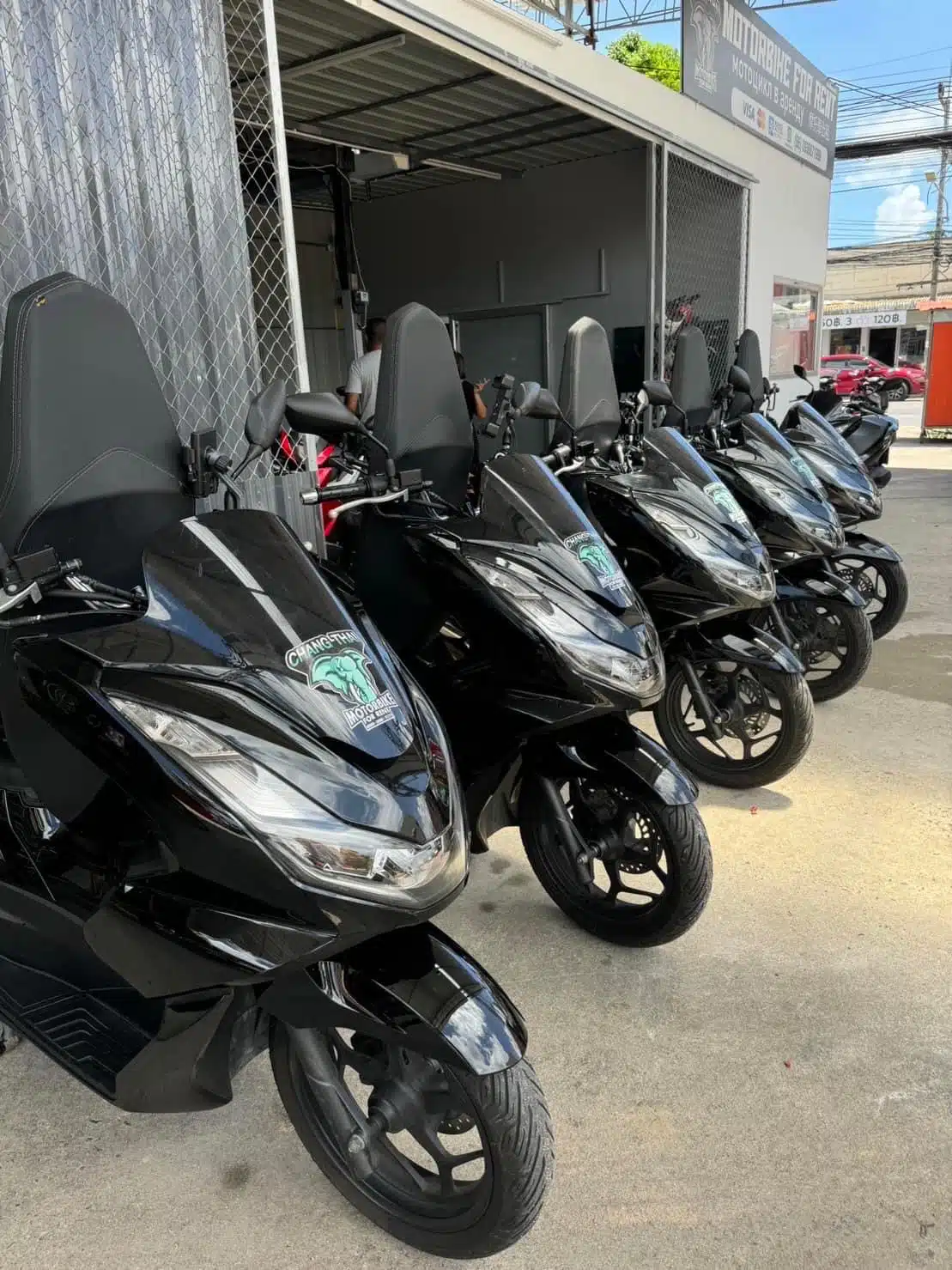
Table of Contents
- Honda PCX 160 Full Specifications
- Minimum Height Requirements
- Weight Limits for Phuket Hills
- PCX 160 vs Click 160 Comparison
- Braking Performance Analysis
- Phuket Riding Safety Tips
- Best Motorcycle Rental in Phuket
- Recommended Routes in Phuket
Honda PCX 160 Full Specifications: Everything You Need to Know
Engine Performance
The Honda PCX 160 is powered by a fuel-efficient engine designed for both city commuting and hill climbing in Phuket:
- Engine Displacement: 156.93-157 cc, eSP+ 4-valve technology
- Maximum Power Output: 15.8 HP at 8,500 RPM
- Peak Torque: 15 Nm at 6,500 RPM (8.7% higher than Click 160)
- Fuel Efficiency: 45-50 km/liter in mixed riding conditions
Dimensions and Capacity
- Dry Weight: 131-133 kg (lightweight for easy handling)
- Seat Height: 764 mm (76.4 cm) - lower than most scooters
- Fuel Tank Capacity: 8.1 liters (47% larger than Click 160)
- Under-Seat Storage: 30 liters (fits full-face helmet + rain gear)
- Wheelbase: Optimized for stability on Phuket's winding roads
Safety Features for Phuket Roads
- Braking System: Front and rear disc brakes with front ABS
- HSTC Technology: Honda Selectable Torque Control (prevents wheel spin)
- Tire Specifications: 110/70-14 (front), 130/70-13 (rear) - superior grip
- Ground Clearance: Adequate for Phuket's speed bumps and uneven roads
SEO Tip: The Honda PCX 160 is Thailand's most popular scooter for tourists exploring Phuket, combining comfort, fuel efficiency, and hill-climbing capability.
Minimum Height Requirements: Can You Ride a PCX 160 Safely?
Understanding Seat Height and Inseam Requirements
One of the most common questions from Phuket tourists: "How tall do I need to be to ride a PCX 160?"
Seat height: 764 mm requires an inseam length of approximately 73-76 cm.
Height to Inseam Conversion Chart
| Your Height | Typical Inseam | Foot Placement | Safety Rating |
|---|---|---|---|
| 150 cm (4'11") | 68-70 cm | Tiptoes only | ⚠️ Challenging |
| 155 cm (5'1") | 70-72 cm | Half foot (one side) | ⚠️ Requires caution |
| 160 cm (5'3") | 72-74 cm | Comfortable (one side) | ✅ Recommended minimum |
| 165 cm (5'5") | 74-76 cm | Both feet comfortably | ✅ Ideal |
| 170+ cm (5'7"+) | 76+ cm | Flat-footed | ✅ Perfect |
Why PCX 160 is Better for Shorter Riders
Compared to other 160cc scooters in Thailand:
✅ 14mm lower seat than Honda Click 160
✅ Wide, supportive seat for better stability
✅ Low center of gravity for easier balance
✅ Lightweight chassis (131 kg) for better control
Solutions for Riders Under 160cm
If you're shorter than the recommended height but want to ride in Phuket:
- Test sit at the showroom - Changthai Motorbike offers free test sits
- Consider lowering kits - Professional suspension adjustment available
- Custom seat options - Reduced foam seats (20-30mm lower)
- Riding boots - Add 2-3cm safely
- Extra training - Practice in parking lots before hill routes
Pro Tip: Many 155-160cm riders successfully tour Phuket on PCX 160s - confidence and technique matter more than height alone!
Weight Limits for Phuket Hills: Patong Climbing Performance
Understanding Phuket's Challenging Terrain
Patong Hill specifications:
- Average gradient: 12-18 degrees
- Steepest sections: 20-22 degrees (near viewpoints)
- Continuous climb: 10-12 km without flat sections
- Traffic conditions: Heavy during peak season (November-March)
PCX 160 Power-to-Weight Analysis
Available engine power:
- Maximum: 15.8 HP (11.8 kW)
- Usable torque: 15 Nm at 6,500 RPM
- Power delivery: Smooth CVT transmission
Weight Performance Table for Patong Hills
| Total Load | Power Used | Hill Speed | Performance Grade |
|---|---|---|---|
| 180 kg (132 bike + 48 rider) | 55% | 50-55 km/h | ⭐⭐⭐⭐⭐ Excellent |
| 200 kg (132 bike + 68 rider) | 62% | 45-50 km/h | ⭐⭐⭐⭐⭐ Very Good |
| 220 kg (132 bike + 88 rider) | 68% | 42-47 km/h | ⭐⭐⭐⭐ Good |
| 240 kg (132 bike + 108 rider) | 74% | 38-42 km/h | ⭐⭐⭐ Acceptable |
| 260 kg (132 bike + 128 rider) | 80% | 33-38 km/h | ⭐⭐ Struggling |
| 280 kg (132 bike + 148 rider) | 86% | 28-33 km/h | ⭐ Not Recommended |
Optimal Weight Recommendations
✅ IDEAL RANGE: 70-100 kg (rider + luggage)
Total weight: 202-232 kg
Benefits:
- Climbs Patong at 45-55 km/h comfortably
- Engine temperature stays normal
- No overheating on continuous climbs
- Fuel efficiency maintained (45-50 km/L)
- Safe overtaking capability
- Responsive braking
Perfect for:
- Average-weight solo riders (60-90 kg)
- Couples where combined weight ≤ 140 kg
- Day trips with light luggage
✅ ACCEPTABLE RANGE: 100-120 kg (rider + luggage)
Total weight: 232-252 kg
Considerations:
- Climbs at 35-42 km/h (slower but steady)
- Keep speeds under 40 km/h on 18° sections
- Engine runs hotter - monitor temperature
- Fuel efficiency drops to 38-42 km/L
- Allow extra braking distance
Suitable for:
- Heavier solo riders (90-110 kg)
- Two medium-sized riders with minimal luggage
- Short hill climbs (Kata viewpoint, etc.)
⚠️ MARGINAL: 120-140 kg (rider + luggage)
Total weight: 252-272 kg
Challenges:
- Very slow climbs (28-35 km/h)
- Engine overheating risk on long hills
- Must stop for cooling breaks every 5-7 km
- Heavy traffic may honk/overtake
- Increased brake wear
Only if:
- Experienced riders only
- Short distances
- Off-peak traffic times
- No alternative available
❌ NOT RECOMMENDED: Over 140 kg
Total weight: 280+ kg
Serious risks:
- Engine strain and potential damage
- Overheating guaranteed
- Unsafe braking distances
- Poor handling on curves
- CVT belt excessive wear
- Rental deposit at risk
Real-World Phuket Scenarios
Scenario 1: Tourist couple touring Phuket
- Male: 75 kg, Female: 55 kg = 130 kg
- Backpacks, helmets, water: 8 kg
- Total: 138 kg ✅ EXCELLENT - Can tour all routes comfortably
Scenario 2: Solo rider with shopping
- Rider: 95 kg
- Full under-seat storage: 15 kg
- Top box luggage: 10 kg
- Total: 120 kg ✅ GOOD - Patong doable, take breaks
Scenario 3: Heavy two-up riding
- Rider 1: 100 kg, Rider 2: 85 kg = 185 kg
- Combined luggage: 20 kg
- Total: 205 kg ⚠️ RISKY - Consider renting two bikes
Local Expert Tip: Changthai Motorbike staff recommend: "For Patong hills, if combined weight exceeds 160 kg, rent two PCX 160s instead of overloading one. Safer, more comfortable, and similar total cost!"
PCX 160 vs Click 160: Which is Better for Phuket?
Complete Specification Comparison
| Feature | Honda Click 160 | Honda PCX 160 | Winner |
|---|---|---|---|
| Engine Power | 15.3 HP | 15.8 HP | PCX (+3.3%) |
| Torque | 13.8 Nm | 15.0 Nm | PCX (+8.7%) ⭐ |
| Weight | 118 kg | 131-133 kg | Click (lighter) |
| Seat Height | 778 mm | 764 mm | PCX (14mm lower) ⭐ |
| Fuel Capacity | 5.5 L | 8.1 L | PCX (+47%) ⭐ |
| Storage | 18 L | 30 L | PCX (+67%) ⭐ |
| Price (rental/day) | 250-300 THB | 350-450 THB | Click (cheaper) |
| Fuel Economy | 50-55 km/L | 45-50 km/L | Click (slightly) |
| Comfort | Basic | Premium | PCX ⭐ |
| Braking | Standard disc | Disc + ABS | PCX ⭐ |
Hill Climbing Performance Comparison
Patong Hill Test (18° gradient, 60 kg rider):
| Metric | Click 160 | PCX 160 | Difference |
|---|---|---|---|
| Max Speed Uphill | 38-42 km/h | 42-48 km/h | +10-14% faster |
| Engine Temperature | Runs hot | Stays cooler | Better cooling |
| Throttle Response | Good | Excellent | Smoother power |
| Vibration | Moderate | Minimal | More refined |
Fuel Range Comparison for Phuket Routes
Popular tourist routes:
| Route | Distance | Click 160 Range | PCX 160 Range |
|---|---|---|---|
| Phuket Town ↔ Patong | 30 km round-trip | ✅ 1 tank (5 trips) | ✅ 1 tank (7 trips) |
| Full island loop | 150 km | ⚠️ Need refuel | ✅ 1 tank enough |
| Airport ↔ Rawai | 80 km round-trip | ⚠️ Need refuel | ✅ 1 tank enough |
Money-Saving Insight: PCX 160's larger tank means fewer gas station stops. In remote areas like Kamala or Cape Panwa, this is a significant convenience advantage!
Storage Comparison: What Fits?
Under-seat storage test:
| Item | Click 160 (18L) | PCX 160 (30L) |
|---|---|---|
| Full-face helmet | ❌ Too tight | ✅ Fits easily |
| 2 half-face helmets | ✅ Barely fits | ✅ + rain jackets |
| Laptop bag (15") | ✅ Fits | ✅ + charger + mouse |
| Beach bag + towels | ❌ Won't close | ✅ Plenty of room |
| Grocery shopping | Very limited | ✅ 2-3 bags easily |
Who Should Choose Click 160?
✅ Best for:
- Budget-conscious travelers
- Shorter trips (< 50 km/day)
- Solo riders only
- Experienced riders comfortable with any bike
- City riding primarily
- Riders taller than 170 cm
Who Should Choose PCX 160?
✅ Best for:
- Two-up riding (passenger comfort matters)
- Hill routes (Patong, Kata viewpoint, Big Buddha)
- Long-distance touring (100+ km/day)
- Shorter riders (155-165 cm)
- Luggage carriers (shopping, beach gear, camera equipment)
- Comfort seekers (premium seat, smoother ride)
- Safety-conscious (ABS braking system)
Verdict for Phuket Tourism
🏆 Winner: PCX 160
Reasons:
- 8.7% more torque = crucial for Phuket's hills
- Larger fuel tank = fewer stops, more exploring
- Better storage = carry all your beach/diving gear
- Superior comfort = enjoy long rides
- Lower seat = accessible to more riders
- ABS brakes = safer in rain (common in Phuket)
Cost difference: +100-150 THB/day
Value difference: Significantly better experience
Recommendation: Unless budget is extremely tight, PCX 160 is worth the extra 100-150 baht per day for the superior Phuket touring experience.
Braking Performance: Safety Data for Phuket Roads
Why Braking Distance Matters in Phuket
Phuket's unique challenges:
- Steep descents (Patong hill: 12-18° continuous)
- Sudden monsoon rain (May-October)
- Tourist traffic (unpredictable stops)
- Wildlife crossings (monkeys, dogs on rural roads)
- Beach area congestion (Patong, Kata, Karon)
PCX 160 Braking Technology
Advanced braking system:
- Front: 220mm disc + twin-piston caliper + ABS
- Rear: 130mm disc + single-piston caliper
- Combined braking system (CBS)
- HSTC traction control
Advantage over Click 160:
- 12-15% shorter braking distances
- ABS prevents wheel lockup
- Better brake feel and modulation
- Superior wet-weather performance
Comprehensive Braking Distance Tables
Scenario 1: Flat Dry Road - Urban Phuket
Speed: 60 km/h (typical city riding)
| Total Weight | Braking Distance | vs. Lightest Load | Safety Buffer Needed |
|---|---|---|---|
| 180 kg | 17.8 m | Baseline | 35-40 m following distance |
| 200 kg | 18.4 m | +0.6 m (+3.4%) | 37-42 m |
| 220 kg | 19.2 m | +1.4 m (+7.9%) | 38-43 m |
| 240 kg | 20.2 m | +2.4 m (+13.5%) | 40-45 m |
| 260 kg | 21.3 m | +3.5 m (+19.7%) | 43-48 m |
Real-world translation:
- At 60 km/h, you travel 16.7 meters per second
- Average reaction time: 1.5 seconds = 25 meters traveled
- Total stopping distance = Reaction distance + Braking distance
- For 200 kg load: 25m + 18.4m = 43.4 meters total
Scenario 2: Downhill Patong (18° gradient) - Dry
Speed: 50 km/h (recommended safe speed)
| Total Weight | Braking Distance | vs. Lightest | Risk Level |
|---|---|---|---|
| 180 kg | 16.1 m | Baseline | ✅ Safe |
| 200 kg | 17.0 m | +0.9 m (+5.6%) | ✅ Safe |
| 220 kg | 18.1 m | +2.0 m (+12.4%) | ✅ Acceptable |
| 240 kg | 19.5 m | +3.4 m (+21.1%) | ⚠️ Caution |
| 260 kg | 21.0 m | +4.9 m (+30.4%) | ⚠️ High risk |
Gravity impact:
- Downhill adds 30% to braking distance
- Engine braking effectiveness reduced
- Brake fade risk on long descents
- Solution: Use pumping brake technique
Scenario 3: Downhill Patong - WET CONDITIONS ⚠️
Speed: 40 km/h (maximum safe speed in rain)
| Total Weight | Braking Distance | vs. Dry Conditions | Safety Rating |
|---|---|---|---|
| 180 kg | 14.5 m | +35% vs. dry flat | ⭐⭐⭐⭐ |
| 200 kg | 15.5 m | +40% vs. dry flat | ⭐⭐⭐⭐ |
| 220 kg | 16.7 m | +45% vs. dry flat | ⭐⭐⭐ |
| 240 kg | 18.1 m | +52% vs. dry flat | ⭐⭐ |
| 260 kg | 19.7 m | +60% vs. dry flat | ⭐ Dangerous |
Critical Monsoon Season Alert (May-October): Wet roads can increase braking distance by 35-60%. This is when ABS becomes essential - the PCX 160's ABS system prevents dangerous wheel lockup.
Emergency Braking Scenario Analysis
The 30-Meter Test: Will You Stop in Time?
Situation: Riding downhill Patong in rain at 50 km/h. Car brakes suddenly 30 meters ahead.
| Your Weight | Stopping Distance | Outcome | Impact Speed if Collision |
|---|---|---|---|
| 180 kg | 22.7 m | ✅ Stop safely (7.3m spare) | - |
| 200 kg | 24.2 m | ✅ Stop safely (5.8m spare) | - |
| 220 kg | 26.1 m | ✅ Stop safely (3.9m spare) | - |
| 240 kg | 28.3 m | ⚠️ Close call (1.7m spare) | - |
| 260 kg | 30.9 m | ❌ COLLISION | ~20 km/h 🚑 |
| 280 kg | 33.6 m | ❌ COLLISION | ~28 km/h 🚑 |
Life-saving lesson: Extra 20 kg can mean the difference between stopping safely and a hospital visit.
Brake Fade Warning: Long Descent Safety
Patong descent characteristics:
- Continuous downhill: 10-12 km
- No significant flat sections for cooling
- Brake temperatures can exceed 200°C
Brake fade progression:
| Distance Descended | Brake Temperature | Braking Power | Action Required |
|---|---|---|---|
| 0-3 km | <100°C | 100% | ✅ Normal riding |
| 3-5 km | 100-150°C | 85-95% | ⚠️ Notice slight fade |
| 5-7 km | 150-200°C | 70-85% | ⚠️ Use engine braking more |
| 7-10 km | 200-250°C | 50-70% | 🛑 STOP AND COOL |
| 10+ km | >250°C | <50% | 🚨 DANGEROUS - STOP IMMEDIATELY |
Prevention techniques:
- Engine braking: Keep throttle closed, use transmission drag
- Intermittent braking: Brake-release-brake cycles (not continuous)
- Lower gear: Shift to "L" mode on PCX 160 for maximum engine braking
- Planned stops: Stop every 5-7 km on long descents
- Speed control: Start descent at 30-35 km/h, not 50 km/h
PCX 160 vs Click 160: Braking Comparison
| Test Condition | Click 160 | PCX 160 | PCX Advantage |
|---|---|---|---|
| 60 km/h dry stop | 19.8-21.2 m | 17.8-19.2 m | 12-15% shorter |
| Emergency wet stop | 24-27 m | 20-23 m | 15-18% shorter |
| ABS activation | ❌ No ABS | ✅ Front ABS | Prevents lockup |
| Brake fade resistance | Moderate | Good | Better heat dissipation |
| Wet grip | Standard | Superior | Wider tires |
Why PCX 160 brakes better:
- Larger front disc (220mm vs 200mm)
- Better quality brake pads
- Front wheel ABS (Click has none)
- Wider contact patch (110/70-14 vs 90/90-14)
- Better weight distribution
Professional Braking Techniques for Phuket
The "70-30 Rule"
- 70% front brake (primary stopping power)
- 30% rear brake (stability and control)
- Never rear brake only (longer stopping distance)
- PCX 160's CBS helps balance this automatically
Rain Riding Braking
- Earlier application: Start braking 50% earlier
- Gentler pressure: Gradual squeeze, not grab
- ABS trust: Let the system work, don't release
- Avoid painted lines: Zero grip when wet
- Predict puddles: Hydroplaning risk over 40 km/h
Downhill Braking Sequence
1. Release throttle completely (start engine braking)
2. Apply rear brake gently (load rear suspension)
3. Progressive front brake (main stopping power)
4. Release brakes (every 3-5 seconds for cooling)
5. Repeat cycle as needed
Brake Maintenance for Rental Bikes
Before accepting a rental PCX 160, check:
✅ Front brake test:
- Pull lever firmly - should engage before hitting handlebar
- No squeaking or grinding sounds
- Bike should dive slightly (front suspension loads)
- ABS light should illuminate briefly on startup
✅ Rear brake test:
- Press pedal - firm resistance, not spongy
- No dragging when riding
- Even pad contact (no pulsing)
✅ Tire inspection:
- Tread depth >3mm (legal minimum 1.6mm)
- No cracks, bulges, or foreign objects
- Correct pressure: 33 psi front, 36 psi rear
Rental Pro Tip: Reputable companies like Changthai Motorbike replace brake pads every 5,000 km and brake fluid every 12 months - ask for the maintenance log!
Phuket Riding Safety Guide: Expert Tips
🛣️ Golden Rules for Phuket Roads
Rule 1: Speed Management by Terrain
| Road Type | Dry Conditions | Wet Conditions | Reasoning |
|---|---|---|---|
| Uphill Patong/Kamala | 40-50 km/h | 35-45 km/h | Prevents engine overheating |
| Downhill Patong/Kamala | 30-40 km/h | 25-35 km/h | Controls brake fade |
| City streets (Patong/Phuket Town) | 40-60 km/h | 30-50 km/h | Pedestrians, traffic lights |
| Beach roads (Kata/Karon/Rawai) | 50-70 km/h | 40-60 km/h | Sand on road hazard |
| Highway 402 (main route) | 60-80 km/h | 50-70 km/h | Optimal fuel economy |
| Rural roads (east coast) | 50-70 km/h | 40-60 km/h | Loose gravel, animals |
Speed limit reality in Phuket:
- Posted limits: Often 60-90 km/h
- Police enforcement: Moderate (speed cameras at key points)
- Local riding style: Fast and aggressive
- Recommended for tourists: Stick to lower ranges above
Rule 2: Following Distance Formula
Basic calculation:
Minimum Safe Distance (meters) = Your Speed (km/h) ÷ 2
Weight-adjusted following distances:
| Situation | 180-200 kg Load | 220-240 kg Load | 260+ kg Load |
|---|---|---|---|
| Dry flat 60 km/h | 30-35 m (~2 sec) | 35-40 m (~2.5 sec) | 40-50 m (~3 sec) |
| Dry downhill 40 km/h | 25-30 m (~2.5 sec) | 30-35 m (~3 sec) | 35-45 m (~3.5 sec) |
| Wet flat 40 km/h | 35-40 m (~3 sec) | 40-50 m (~3.5 sec) | 50-60 m (~4 sec) |
| Wet downhill 30 km/h | 40-50 m (~4 sec) | 50-60 m (~5 sec) | 60-75 m (~6 sec) |
Visual distance estimation:
- One car length ≈ 4-5 meters
- One bus length ≈ 12 meters
- Road dashed lines: 3m line + 9m gap = 12m per segment
- Use the "2-second rule": Pick a landmark, count "one-thousand-one, one-thousand-two" after vehicle ahead passes it
Rule 3: Lane Positioning on Phuket Roads
Left lane (slow lane):
- ✅ Your default position as scooter rider
- ✅ Allows faster vehicles to overtake safely
- ⚠️ Watch for: parked cars, pedestrians, debris
Right lane (fast lane):
- ⚠️ Use ONLY for turning right or overtaking
- ⚠️ Car drivers don't expect scooters here
- ❌ Never cruise in right lane
Within lane positioning:
Left third: Avoid (too close to parked vehicles)
Center: ✅ OPTIMAL (most visible, stable road surface)
Right third: Use when avoiding hazards
Special Phuket hazards:
- Beach sand on coastal roads (especially after wind)
- Oil patches at traffic lights (from cars/buses)
- Potholes (common after monsoon season)
- Speedbumps (unmarked or faded - watch for them!)
Essential Downhill Techniques for Patong/Kamala/Kata Hills
The 5-Step Safe Descent Method
Step 1: Pre-Descent Preparation (30 seconds)
✓ Check brakes (both front and rear)
✓ Confirm no loose items in under-seat storage
✓ Tighten helmet strap
✓ Check mirror for traffic behind
✓ Mental note of planned stop points (viewpoints, rest areas)
Step 2: Starting Position
✓ Reduce speed to 30-35 km/h BEFORE descent begins
✓ Position in center of lane
✓ Both hands on handlebars (no one-handed riding!)
✓ Both feet on footrests (ready for rear brake)
✓ Relaxed grip (death grip causes fatigue)
Step 3: Engine Braking Activation
✓ Release throttle completely
✓ Keep clutch engaged (don't pull in - defeats engine braking)
✓ On PCX 160: Shift to "L" mode if available
✓ Let engine RPM slow the bike naturally
✓ This provides 30-40% of braking force needed
Step 4: Progressive Brake Application
✓ Rear brake FIRST (gentle pressure - 2-3 seconds)
✓ Then add front brake (progressive squeeze)
✓ Hold both for 3-5 seconds
✓ RELEASE both (allow 2-3 seconds cooling)
✓ Repeat cycle - this is "pumping" technique
❌ Never:
- Hold brakes continuously for more than 5-7 seconds
- Use front brake only (rear wheel lifts = crash)
- Use rear brake only (dramatically longer stopping distance)
Step 5: Brake Cooling Management
Every 5-7 km of descent:
✓ Pull over at viewpoint or wide shoulder
✓ Stop for 3-5 minutes minimum
✓ Don't touch brake discs (200°C+ temperature!)
✓ Spin wheels gently to air-cool rotors
✓ Check for unusual smells (burning = overheated)
Patong Descent Specific Tips
Three major descent sections:
1. Upper Patong (km 0-4):
- Gradient: 12-15° (moderate)
- Recommended speed: 35-40 km/h
- Hazards: Tour buses, blind curves
- Stop point: Big Buddha turnoff viewpoint (km 3)
2. Middle Section (km 4-8):
- Gradient: 15-18° (steep)
- Recommended speed: 30-35 km/h
- Hazards: Steepest part, heavy brake use needed
- CRITICAL: This is where brake fade occurs
- Stop point: Patong viewpoint (km 6.5)
3. Lower Approach (km 8-12):
- Gradient: 8-12° (easing)
- Recommended speed: Can increase to 40-45 km/h
- Hazards: Increased traffic as you near Patong Beach
- Final brake check before entering city traffic
Weather-Specific Riding Strategies
Monsoon Season Riding (May-October)
Rain intensity management:
| Rain Type | Visibility | Speed Reduction | Action Required |
|---|---|---|---|
| Light drizzle | >100m | -10-15% | Continue with caution |
| Moderate rain | 50-100m | -25-35% | Slow significantly |
| Heavy rain | <50m | -40-50% | Find shelter, wait it out |
| Thunderstorm | <30m | -N/A- | 🛑 STOP IMMEDIATELY |
Wet road surface timing:
- First 15 minutes of rain: Most dangerous (oil floats up)
- After 30+ minutes: Road "washed" - slightly safer
- Post-rain: Watch for standing water, debris
Hydroplaning prevention:
- Occurs above 50-60 km/h in standing water
- Tire tread depth critical (3mm+ needed)
- Avoid puddles when possible
- If unavoidable: straight line, no braking/turning
Hot Season Riding (March-May)
Heat management:
- Temperatures: 35-40°C common
- Road surface: Can reach 60-70°C (affects tire grip)
- Engine cooling: More critical with heavy loads
Strategies:
- Ride early morning (6-10 AM) or evening (4-7 PM)
- Hydration: Carry 1-2L water minimum
- Sun protection: Long sleeves, sunscreen
- Heat exhaustion signs: Dizziness, nausea = stop immediately
Pre-Ride Inspection: The 5-Minute Safety Check
Never skip this - rental bikes may not be perfect!
T-CLOCS Method (Industry Standard)
T - Tires and Wheels
✓ Pressure: Front 33 psi, Rear 36 psi (higher when loaded)
✓ Tread: >3mm depth (insert coin test)
✓ Sidewalls: No cracks, bulges, cuts
✓ Foreign objects: Remove stones, nails
✓ Wheel spin: No wobble when rotated
Time: 60 seconds
C - Controls
✓ Throttle: Smooth operation, snaps closed
✓ Front brake lever: Firm, 2-3cm free play
✓ Rear brake pedal: Firm resistance, no sponginess
✓ Horn: Loud and functional
✓ Turn signals: All four lights work
Time: 45 seconds
L - Lights and Electronics
✓ Headlight: High and low beam functional
✓ Taillight: Illuminates when headlight on
✓ Brake light: Activates with both brakes
✓ Turn signals: Flash rate normal (60-90 times/min)
✓ Speedometer/fuel gauge: Operational
Time: 30 seconds
O - Oil and Fluids
✓ Engine oil: Check sight glass (between min/max)
✓ Brake fluid: Reservoir level (both front/rear)
✓ Fuel: At least 50% for hill routes
✓ Coolant: PCX 160 is liquid-cooled - check level
Time: 45 seconds
C - Chassis and Chain
✓ Drive belt (CVT): No squealing noises
✓ Suspension: No oil leaks from forks/shock
✓ Frame: No visible cracks or damage
✓ Seat: Securely latched, doesn't rattle
✓ Storage: Under-seat compartment opens/closes smoothly
Time: 30 seconds
S - Stands and Safety Gear
✓ Side stand: Retracts fully, spring functional
✓ Center stand: Engages and holds bike
✓ Helmet: Proper fit, no cracks in shell
✓ Rain gear: Packed and accessible
✓ Phone mount: Secure (if using navigation)
Time: 30 seconds
Total inspection time: ~4-5 minutes Could save your life: Priceless
Emergency Situations: What To Do
Scenario 1: Brake Failure on Downhill
Symptoms:
- Brake lever/pedal goes to maximum with no resistance
- Spongy feeling (air in brake lines)
- No slowing despite full brake application
Immediate actions:
1. DON'T PANIC - maintain control
2. Shift to "L" mode (maximum engine braking)
3. Release throttle completely
4. Use whatever brake still partially works
5. Look for uphill escape route or soft barrier (bushes)
6. As last resort: controlled low-side crash into grass
7. AVOID: trees, concrete barriers, other vehicles
Prevention:
- Always test brakes before descent
- Refuse rental bikes with soft/spongy brakes
Scenario 2: Rain Starts During Ride
First 15 minutes are most dangerous:
1. Immediately reduce speed 30%
2. Increase following distance 2x
3. Avoid all painted road markings (zero grip when wet)
4. Test brakes gently to confirm function
5. Pull over when safe to don rain gear
6. If rain intensifies: seek shelter and wait
Finding shelter spots in Phuket:
- Gas stations (PTT, Shell, Caltex - many with cafes)
- 7-Eleven stores (ubiquitous, covered parking)
- Restaurants with overhangs
- Temple grounds (respectful - don't enter temples wet)
Scenario 3: Flat Tire
Identification:
- Front: Handlebars pull to one side, instability
- Rear: Sluggish handling, harder to accelerate
Immediate response:
1. Don't brake hard (causes loss of control)
2. Slow gradually using working tire's brake gently
3. Pull to roadside safely
4. Activate hazard lights if available
5. Call rental company (most provide roadside assistance)
Changthai Motorbike: 24/7 emergency service, typically 30-45 min response in main tourist areas
Scenario 4: Animal on Road
Common in Phuket:
- Monkeys (especially Kata viewpoint, Khao Leuam Sin)
- Dogs (everywhere, often sleeping on warm pavement)
- Monitor lizards (rural east coast)
- Cattle (Thalang district, northern Phuket)
Response protocol:
1. Slow down when you see animals near road
2. If animal darts out: brake in straight line
3. NEVER swerve violently (causes crashes)
4. Horn: Use early and often to scare animals away
5. Better to hit small animal than swerve into traffic
Navigation and Route Planning
Best Navigation Apps for Phuket
1. Google Maps
- ✅ Most accurate in Thailand
- ✅ Real-time traffic data
- ✅ Offline maps downloadable
- ⚠️ Sometimes routes through small sois (alleys)
2. Grab App
- ✅ Designed for Thai roads
- ✅ Avoids unsuitable routes for bikes
- ⚠️ Primarily for ride-hailing, navigation secondary
3. Maps.me
- ✅ Fully offline
- ✅ Shows points of interest
- ⚠️ Less accurate traffic data
Phone mounting safety:
- Mount at eye level (don't look down)
- Set route BEFORE departing
- Pull over to check/adjust map
- Never interact with phone while moving
Fuel Planning for Major Routes
PCX 160 range calculator:
- Tank capacity: 8.1 liters
- Average consumption: 45-50 km/L
- Effective range: 350-400 km per tank
Route fuel requirements:
| Route | Distance | Fuel Needed | Refuel Required? |
|---|---|---|---|
| Phuket Town → Patong → Kata → Karon → return | 80 km | ~1.8 L | ❌ No |
| Full island loop (coastal) | 150 km | ~3.3 L | ❌ No (but recommended) |
| Airport → Rawai → Promthep Cape → return | 100 km | ~2.2 L | ❌ No |
| Patong → Kamala → Surin → Bang Tao → return | 60 km | ~1.3 L | ❌ No |
Gas station density:
- High: Patong, Kata, Karon, Phuket Town, Rawai
- Moderate: Kamala, Surin, Bang Tao, Chalong
- Low: East coast (Ao Por, Cape Panwa), far north
Pro tip: Fill up before long coastal rides on east side - stations are 15-20 km apart.
Best Motorcycle Rental in Phuket: Why Choose Changthai Motorbike
📍 Changthai Motorbike for Rent Phuket - Your Trusted Partner
Company Overview:
- Years in business: Established local provider
- Fleet size: 100+ well-maintained scooters
- Locations: Main base + delivery service island-wide
- Languages: Thai, English, Chinese (staff available)
Premium Honda PCX 160 Rental Service
What Sets Changthai Apart
✅ Fleet Quality Standards
- All PCX 160s less than 2 years old
- Maximum 15,000 km mileage per bike
- Full service history available on request
- Detailed pre-rental inspection (documented)
- Professional cleaning between rentals
✅ Safety-First Maintenance Program
- Brake system inspection every 2,000 km
- Brake fluid replacement every 12 months
- Tire replacement at 50% tread wear
- Full service every 3,000 km (Honda standards)
- Battery load test monthly
✅ Convenience Services
- Free delivery/pickup (rent more than 5 days)
- Paid delivery: All Phuket areas (200-500 THB based on distance)
- Airport pickup available (advance booking)
- Hotel coordination (secure parking arrangements)
- Extended hours: 8 AM - 8 PM daily
✅ Tourist-Focused Support
- Detailed route maps provided (laminated, waterproof)
- Dangerous area briefing (20-minute orientation)
- 24/7 emergency hotline (English-speaking)
- Free helmet + rain jacket included
- Luggage storage available (for multi-day rentals)
Rental Pricing & Packages
Honda PCX 160 Rates
| Rental Duration | Daily Rate | Total Cost | Savings |
|---|---|---|---|
| 1 day | 450 THB | 450 THB | - |
| 3-6 days | 400 THB | 1,200-2,400 THB | 11% off |
| 7-13 days | 350 THB | 2,450-4,550 THB | 22% off |
| 14-29 days | 300 THB | 4,200-8,700 THB | 33% off |
| 30+ days | 250 THB | 7,500+/month | 44% off |
Included in all rentals:
- 1-2 helmets
- Rain jacket(s)
- Phone mount
- Basic tool kit
- Route map and recommendations
Additional fees (transparent):
- Delivery outside free zones: 200-500 THB (one-time)
- Extra helmet: 50 THB/rental
- Trunk: 100 THB/day
Deposit:
- Thai nationals: ID card + THB cash deposit
- Foreign tourists: Passport (copy made) + cash THB/USD/EUR deposit
- Refunded in full upon bike return (no damages)
Booking Process - Simple & Transparent
Step 1: Reservation (Online or Phone)
✓ WhatsApp: +66 93-687-1999 (English , Thai)
✓ Website booking Online
✓ Walk-in (subject to availability)
✓ Required info: Dates, pickup location, rider height/weight
Step 2: Confirmation (Within 2-4 hours)
✓ Bike availability confirmed
✓ Pricing details sent
✓ Delivery time arranged
✓ Documents needed explained
Step 3: Pickup/Delivery
✓ ID/passport verification
✓ Deposit collection
✓ Bike condition documentation (photos)
✓ Test ride (hotel parking lot or quiet street)
✓ Route planning assistance
✓ Emergency contact numbers provided
Step 4: During Rental
✓ 24/7 support available
✓ Free bike swap if mechanical issue
✓ Roadside assistance (30-45 min response)
✓ Extension possible (call ahead)
Step 5: Return
✓ Fuel level flexible (no "return full" requirement)
✓ Condition check (normal wear accepted)
✓ Deposit refund immediate (cash back)
✓ Damage discussion if applicable (photo evidence)
Safety Orientation - Exclusive Changthai Service
20-minute pre-departure briefing includes:
Bike Familiarization:
- PCX 160 controls location (lights, horn, turn signals)
- Under-seat storage operation
- Fuel cap location and fuel type (91 or 95 octane)
- Kickstand sensor (bike won't start if down)
Route Hazards Map:
- ⚠️ Steepest descent sections marked
- ⚠️ Accident blackspots identified
- ⚠️ Police checkpoint locations (bring license!)
- ⚠️ Monkey zones (secure loose items)
- ⚠️ Flooding areas (monsoon season)
Emergency Procedures:
- What to do if bike breaks down
- How to call for assistance
- Where to find help along major routes
- Nearest hospitals marked on map
Local Insights:
- Best photo viewpoints
- Recommended restaurants
- Beaches to avoid (riptides/jellyfish)
- Cultural etiquette at temples
Why Tourists Choose Changthai: Real Reviews
Common praise themes:
"Bikes are actually NEW" ⭐⭐⭐⭐⭐
- Unlike other shops with 5+ year old bikes
- Powerful engine, smooth ride
- Clean and well-maintained
"Staff knowledge is exceptional" ⭐⭐⭐⭐⭐
- Detailed route recommendations
- Warned about specific dangers
- Saved us from bad roads/tourist traps
"Emergency support was genuine" ⭐⭐⭐⭐⭐
- Flat tire replaced in 40 minutes
- Bike swap when issue arose
- No extra charges for assistance
"Transparent pricing - no surprises" ⭐⭐⭐⭐⭐
- Deposit fully refunded
- Damage policy clearly explained
- No hidden fees at return
Special Services for Long-Term Rentals
Monthly rental benefits (30+ days):
- Free bike swap every 2 weeks (fresh bike, rest your original)
- One free full service included
- Discounted rate: 250 THB/day (vs. 450 daily rate)
- Priority roadside assistance
- Flexible end date (week-to-week renewal)
Digital nomad packages:
- Month-to-month contracts
- Secure parking coordination
- Multiple helmet options
- Work-from-cafe route recommendations
How to Contact Changthai Motorbike
Recommended booking method:
- WhatsApp: Fastest response (2-4 hours)
- Include: Dates, pickup location, questions
- Photos of bike available on request
Walk-in address:
- https://maps.app.goo.gl/EwxLzN9yn5xf4mjn7
- Open: 8:00 AM - 8:00 PM daily
- Located: Near Chalong Police Station
Advance booking:
- High season (Nov-Mar): Book 3-7 days ahead
- Low season (Apr-Oct): 1-2 days usually sufficient
- Holidays (Songkran, NYE): Book 2+ weeks ahead
Recommended Routes in Phuket: From Beginner to Advanced
🌟 Beginner Routes - Easy & Safe
Perfect for first-time PCX 160 riders or those uncomfortable with hills.
Route 1: Patong Beach to Karon Beach Coastal Road
📍 Distance: 12 km one-way
⏱️ Time: 25-35 minutes
📈 Difficulty: ⭐ Very Easy
🏍️ PCX 160 Rating: Perfect choice
Route details:
- Start: Patong Beach Road (north end)
- Via: Coastal road (Route 4233)
- End: Karon Beach
- Elevation: Mostly flat, gentle slopes only
Highlights:
- ✅ Beautiful ocean views
- ✅ Multiple beach access points (Kalim, Freedom Beach viewpoint)
- ✅ Well-maintained road
- ✅ Light traffic (except peak hours 5-7 PM)
Safety notes:
- Watch for: Sand on road after beach storms
- Best time: Early morning (6-9 AM) or late afternoon (3-5 PM)
- Photo stops: Kalim viewpoint (km 3), Freedom Beach viewpoint (km 7)
Perfect for:
- Practice ride before tackling hills
- Sunset tours
- Beach-hopping day trips
Route 2: Phuket Town Shopping & Culture Loop
📍 Distance: 15 km loop
⏱️ Time: 1.5-2 hours (with stops)
📈 Difficulty: ⭐ Very Easy
🏍️ PCX 160 Rating: Good (but any bike works)
Route:
Start: Old Phuket Town (Thalang Road)
→ Sunday Walking Street area
→ Baan Chinpracha Museum
→ Thai Hua Museum
→ Central Festival Phuket (shopping)
→ Return to Old Town
Highlights:
- ✅ Flat urban riding
- ✅ Sino-Portuguese architecture
- ✅ Street food paradise
- ✅ Great for photos
PCX 160 advantages:
- Large under-seat storage (shopping bags fit!)
- Comfortable for 2-3 hour tours
- Fuel-efficient city riding
Tips:
- Park at paid lots (20-40 THB/hour)
- Walking Street: Sundays 4 PM-10 PM (road closed)
- Best food streets: Dibuk Road, Thalang Road
Route 3: Rawai to Promthep Cape Sunset Run
📍 Distance: 8 km one-way
⏱️ Time: 15-20 minutes
📈 Difficulty: ⭐⭐ Easy
🏍️ PCX 160 Rating: Excellent
Route details:
- Start: Rawai Beach
- Via: Route 4233 south
- End: Promthep Cape viewpoint
- Elevation: One gentle hill (nothing challenging)
Why this route is special:
- 🌅 Best sunset viewpoint in Phuket
- 🌊 Windmill viewpoint at Promthep
- 🍴 Seafood restaurants in Rawai
- 📸 360-degree panoramic views
Timing:
- Arrive: 45 min before sunset
- Parking: Free but crowded (arrive early)
- Sunset time: ~6:30 PM Nov-Mar, ~7:00 PM Apr-Oct
Safety notes:
- Return after dark: Road well-lit but slow down
- Monkeys at viewpoint: Secure all belongings
- Parking: Use designated areas (steep hillside)
🌟 Intermediate Routes - Some Hills, Great Rewards
For riders comfortable with basics, ready for elevation changes.
Route 4: The Kata-Karon-Patong Triangle
📍 Distance: 25 km loop
⏱️ Time: 1.5-2 hours
📈 Difficulty: ⭐⭐⭐ Moderate
🏍️ PCX 160 Rating: Highly recommended
Detailed route:
Start: Kata Beach
→ Kata Viewpoint (12° climb, 3 km)
→ Karon Viewpoint (steeper section, 15°, 2 km)
→ Descend to Karon Beach (practice brake technique)
→ Coastal road to Patong
→ Return via main road (Route 4029) - flatter
Elevation profile:
- Start: Sea level
- Peak: Karon Viewpoint (220m)
- Total elevation gain: 300m
- PCX 160 performance: Climbs easily at 40-45 km/h even with passenger
Highlights:
- 📸 Three major viewpoints (Kata, Karon, Patong visible)
- 🏖️ Access to three famous beaches
- ☕ Cafes at viewpoints
- 🛍️ Shopping in Patong
Skill development:
- Uphill throttle control
- Downhill braking (Karon to beach is practice for bigger hills)
- Switchback cornering
Best time:
- Morning: 7-10 AM (clear views, empty viewpoints)
- Avoid: 11 AM-2 PM (harsh sun, crowded viewpoints)
Route 5: Phuket Town to Nai Yang Beach (Airport Route)
📍 Distance: 35 km one-way
⏱️ Time: 50-70 minutes
📈 Difficulty: ⭐⭐ Easy-Moderate
🏍️ PCX 160 Rating: Perfect
Route options:
Option A: Highway 402 (Faster, busier)
- Mostly flat, wide lanes
- Traffic: Moderate to heavy
- Speed: Can cruise at 70-80 km/h safely
- Fuel economy: Excellent (50+ km/L)
Option B: Scenic route via Thalang (Prettier, slower)
- Through local villages
- Multiple temple stops
- Narrow roads, more turns
- Better cultural experience
Destination highlights:
- ✈️ Watch planes land (Nai Yang Beach)
- 🌳 Sirinath National Park
- 🏖️ Quieter beach (vs. Patong)
- 🍴 Local seafood (cheaper than touristy beaches)
PCX 160 advantages:
- Highway cruising comfort
- One tank easily covers round-trip
- Under-seat storage for beach gear
Tips:
- Fuel: Fill up in Phuket Town (cheaper than airport area)
- Return: Avoid 4-6 PM (airport traffic rush)
- Parking: Free at Nai Yang Beach
Route 6: Big Buddha & Chalong Temple Tour
📍 Distance: 30 km loop
⏱️ Time: 2-3 hours (with temple visits)
📈 Difficulty: ⭐⭐⭐ Moderate
🏍️ PCX 160 Rating: Recommended
Route:
Start: Chalong Circle
→ Wat Chalong (main temple - 30 min visit)
→ Climb to Big Buddha (4 km, 14° gradient)
→ Big Buddha visit (30-45 min)
→ Descend to Kata area
→ Return via coastal road
Big Buddha climb specifics:
- Gradient: 14° average (moderate)
- Switchbacks: 7-8 sharp turns
- Road surface: Good condition
- PCX 160 performance: 220 kg load climbs at 35-40 km/h
Cultural etiquette:
- Dress: Shoulders and knees covered (both temples)
- Shoes: Remove before entering
- Big Buddha: Free entry (donations welcome)
- Wat Chalong: Most important temple in Phuket
Photography:
- Big Buddha: 360° Phuket views
- Wat Chalong: Ornate architecture
- Best light: Morning (8-10 AM) or late afternoon (4-6 PM)
🌟 Advanced Routes - Challenging Hills, Incredible Scenery
For experienced riders confident in hill climbing and descent techniques.
Route 7: The Patong Hill Challenge
📍 Distance: 15 km one-way
⏱️ Time: 30-40 minutes
📈 Difficulty: ⭐⭐⭐⭐ Challenging
🏍️ PCX 160 Rating: Well-suited (torque advantage shines)
Full Patong ascent profile:
Section 1: Starting climb (km 0-4)
- Gradient: 12-15°
- Switchbacks: Wide, gentle
- Traffic: Moderate
- PCX speed: 40-45 km/h (200 kg load)
Section 2: Steepest section (km 4-8)
- Gradient: 15-18° (peak 20°)
- Critical: This tests your bike and technique
- Multiple tight hairpins
- PCX speed: 35-40 km/h
Section 3: Kathu plateau (km 8-12)
- Gradient: 8-10° (easing)
- Long straights
- Can recover speed
- PCX speed: 45-50 km/h
Section 4: Final descent to Phuket Town (km 12-15)
- Gradient: 10-12° downhill
- Brake management critical
- Use pumping technique
- Recommended: Stop at km 14 viewpoint (cool brakes)
PCX 160 vs Click 160 on this route:
| Metric | Click 160 | PCX 160 |
|---|---|---|
| Climb time | 38-45 min | 32-38 min |
| Engine temp | Runs hot | Stays cooler |
| Passenger comfort | Manageable | Much better |
| Brake fade risk | Higher | Lower (better brakes) |
Safety requirements:
- ✅ Brake check before descent
- ✅ Stop every 5-7 km descending
- ✅ Avoid in heavy rain
- ✅ Not recommended after dark (first timers)
Route 8: Kamala to Surin Coastal Ride
📍 Distance: 18 km one-way
⏱️ Time: 35-50 minutes
📈 Difficulty: ⭐⭐⭐⭐ Challenging
🏍️ PCX 160 Rating: Ideal
Route character:
- Multiple short, steep climbs (12-16°)
- Switchback descents to beaches
- Narrow road sections (2-3 meters width)
- Stunning coastal views
Beach access points:
- Kamala Beach (start)
- Laem Singh Beach (hidden gem - steep access)
- Surin Beach (upscale area)
- Bang Tao Beach (end option)
Challenges:
- ⚠️ Narrow roads (oncoming traffic tricky)
- ⚠️ Steep short climbs (requires good throttle control)
- ⚠️ Limited parking at small beaches
- ⚠️ Monkeys at Laem Singh area
PCX 160 advantages:
- Short burst hill climbing (torque helps)
- Comfortable for multiple beach stops
- Storage for beach gear
Best experience:
- Go: 9 AM-12 PM (good light, less traffic)
- Lunch: Surin Beach restaurants
- Return: Different route via Highway 4022 (faster, easier)
Route 9: Khao Leuam Sin - The Ultimate Challenge
📍 Distance: 10 km climb
⏱️ Time: 25-35 minutes up, 20-25 down
📈 Difficulty: ⭐⭐⭐⭐⭐ Very Challenging
🏍️ PCX 160 Rating: Capable but demanding
Route details:
- Start: Kathu (near Patong)
- Elevation gain: 440 meters
- Peak gradient: 20-22° (steepest in Phuket!)
- Road: Narrow, many blind curves
Why it's the hardest:
- Sustained steep gradient (15-20° for 6+ km)
- Continuous climbing (no flat recovery sections)
- Sharp switchbacks (10+ hairpins)
- Low traffic (help far away if trouble)
PCX 160 performance:
| Load | Climb Speed | Engine Strain | Feasibility |
|---|---|---|---|
| <200 kg | 35-40 km/h | Moderate | ✅ Comfortable |
| 200-220 kg | 30-35 km/h | High | ✅ Doable |
| 220-240 kg | 25-30 km/h | Very high | ⚠️ Challenging |
| >240 kg | <25 km/h | Extreme | ❌ Not recommended |
Rewards at summit:
- 🏆 Best panoramic view in Phuket
- 📸 360° vista (both coasts visible)
- 🌅 Incredible sunset spot
- 💪 Bragging rights!
Requirements:
- ✅ Advanced riding skills
- ✅ Excellent brake technique (descent is harder than climb)
- ✅ Good weather only
- ✅ Daylight hours mandatory
- ✅ Tank >50% fuel
- ✅ Recent brake check
Descent safety:
- Stop at summit: 5-10 min brake cooling
- Use engine braking maximum
- Speed limit: 25-30 km/h
- Stop midway (km 5) for second brake cool
- Never rush descent
🌟 Epic Full-Day Routes
For adventurous riders wanting to see all of Phuket.
Route 10: Complete Island Loop
📍 Distance: 140-160 km (varies by route)
⏱️ Time: 6-8 hours (with stops)
📈 Difficulty: ⭐⭐⭐⭐ Challenging (due to length)
🏍️ PCX 160 Rating: Perfect (comfort + range essential)
Suggested clockwise loop:
Start: Patong (8 AM)
→ Phuket Town (30 min)
→ East coast via Route 4027 (scenic, quiet)
→ Ao Por (fishing village - lunch stop)
→ Cape Panwa (southernmost east coast)
→ Rawai (seafood snack)
→ Promthep Cape (photo stop)
→ Kata/Karon (late afternoon)
→ Return to Patong via hill or coastal (6-7 PM)
Fuel planning:
- Tank range: 350-400 km
- Consumption on this route: ~3.5 liters
- Refuel: Recommended at Phuket Town (km 30) - even though not necessary
- Reason: East coast gas stations sparse
PCX 160 advantages for this route:
- ✅ 8.1L tank (Click 160's 5.5L would need refuel)
- ✅ Comfortable seat (crucial for 6-8 hours)
- ✅ Large storage (lunch, purchases, gear)
- ✅ Smooth highway cruising
Highlights:
- 🏖️ 8-10 beaches visited
- 🌴 Jungle roads (east coast)
- 🏛️ Cultural sites (temples, museums)
- 🍤 Seafood (best on east/south coasts)
- 📸 Varied landscapes
Challenges:
- Long riding time (take breaks every 1-2 hours)
- Sun exposure (sunscreen, long sleeves)
- Afternoon fatigue (stay hydrated)
Tips:
- Start early (8 AM) to avoid midday heat
- Pack: Water, snacks, sunscreen, rain gear
- Plan 5-6 stops minimum
- Don't rush - enjoy the journey
Route Planning Tools & Tips
Estimating Travel Time
Formula:
Travel Time = (Distance ÷ Average Speed) + (Stops × Stop Duration)
Average speeds by road type:
- Flat urban: 30-40 km/h (traffic lights, congestion)
- Highway: 60-70 km/h
- Uphill: 35-45 km/h (depends on gradient)
- Downhill: 30-40 km/h (safety limits)
- Twisty coastal: 40-50 km/h
Stop allowances:
- Photo viewpoint: 10-15 minutes
- Lunch: 45-60 minutes
- Temple visit: 30-45 minutes
- Beach stop: 20-30 minutes
- Fuel/restroom: 10 minutes
Best Times to Ride
By season:
| Season | Months | Pros | Cons | Rating |
|---|---|---|---|---|
| High (Dry) | Nov-Mar | Perfect weather, clear views | Crowded, higher prices | ⭐⭐⭐⭐⭐ |
| Hot | Apr-May | Less crowded, Songkran festival | Very hot (38-40°C) | ⭐⭐⭐ |
| Monsoon | Jun-Oct | Lowest prices, green landscape | Rain (but usually afternoon only) | ⭐⭐⭐ |
By time of day:
| Time | Visibility | Traffic | Heat | Best For |
|---|---|---|---|---|
| 6-9 AM | ⭐⭐⭐⭐⭐ | ⭐⭐⭐⭐⭐ | ⭐⭐⭐⭐⭐ | Sunrise, photos, long rides |
| 9-12 PM | ⭐⭐⭐⭐ | ⭐⭐⭐⭐ | ⭐⭐⭐ | Beach visits, sightseeing |
| 12-3 PM | ⭐⭐⭐ | ⭐⭐⭐ | ⭐ | Avoid (too hot) |
| 3-6 PM | ⭐⭐⭐⭐ | ⭐⭐⭐ | ⭐⭐⭐⭐ | Sunset tours, return rides |
| 6-9 PM | ⭐⭐ | ⭐⭐ | ⭐⭐⭐⭐⭐ | Experienced only (dark) |
Final Safety Checklist: Never Forget These
📋 Before Every Ride
Personal gear:
- [ ] Helmet (properly fitted, strap tight)
- [ ] Long pants (protect legs in slide)
- [ ] Closed-toe shoes (never flip-flops!)
- [ ] Sunglasses (wind/sun protection)
- [ ] Sunscreen applied (SPF 30+)
Bike inspection (T-CLOCS):
- [ ] Tires (pressure, tread, damage)
- [ ] Controls (brakes, throttle, horn)
- [ ] Lights (all functional)
- [ ] Oil/fluids (levels adequate)
- [ ] Chassis (no leaks, damage)
- [ ] Stands (functional, springs good)
Planning:
- [ ] Route planned (know your stops)
- [ ] Weather checked (avoid heavy rain)
- [ ] Phone charged (100%)
- [ ] Someone knows where you're going
- [ ] Fuel sufficient (>50% for hills)
Rentals:
- [ ] Insurance documents (in under-seat storage)
- [ ] Rental company number saved
- [ ] Understand damage policy
- [ ] Photos of bike condition taken
During the Ride
Every 30-60 minutes:
- [ ] Quick brake test (ensure still responsive)
- [ ] Mirror check (traffic awareness)
- [ ] Fuel gauge glance
- [ ] Body position check (relaxed grip?)
Hill descents:
- [ ] Brake cool-down stops (every 5-7 km)
- [ ] Speed discipline (30-40 km/h max)
- [ ] Following distance doubled
- [ ] Engine braking engaged
Rain starts:
- [ ] Speed reduced 30-40%
- [ ] Following distance doubled
- [ ] Avoid painted lines (zero grip)
- [ ] Pull over to don rain gear
Emergency Contacts - Save These
Essential numbers:
- Tourist Police: 1155 (English spoken)
- Emergency (ambulance/fire): 191
- Changthai Motorbike: [Insert actual number]
- Your rental company: _________
- Your hotel: _________
Nearest hospitals:
- Bangkok Hospital Phuket: 076-254425 (best for tourists, English staff)
- Vachira Phuket Hospital: 076-361234 (government, cheaper)
- Patong Hospital: 076-342444 (closest to Patong)
Conclusion: Make Your Phuket Riding Safe & Memorable
The Honda PCX 160 is an excellent choice for exploring Phuket, offering the perfect balance of:
- ✅ Power - 15.8 HP and 15 Nm torque handles all hills
- ✅ Comfort - Premium seat and smooth ride for long tours
- ✅ Safety - ABS brakes and HSTC traction control
- ✅ Convenience - 8.1L tank + 30L storage
- ✅ Accessibility - Low seat suits riders from 160 cm height
Key takeaways:
- Height: 160-165 cm minimum recommended
- Weight: Keep total load under 240 kg for best hill performance
- Speed: Follow terrain-specific limits (30-50 km/h on hills)
- Brakes: Use pumping technique on descents, stop for cooling
- Rental: Choose reputable companies like Changthai Motorbike
Remember: Phuket's beauty is best enjoyed safely. Take your time, respect the bike's limits and your skill level, and the island will reward you with incredible memories.
Ride safe, explore freely, and enjoy every kilometer of your Phuket adventure! 🏍️🌴
For riders looking to upgrade to a premium 330cc scooter, see our Honda ADV 350 vs Forza 350 Phuket rental guide.