
By a Phuket Local | Chang Thai Rentals Travel Guide
-----
If you’ve been in Phuket longer than a week, you already know that the island wears two faces. There’s the tourist face — sunburned and smelling of Patong’s tiger balm — and then there’s the real face, the one the locals know: sun-baked temple rooftops, red-dust back roads winding up into the hills, and viewpoints so quiet you can hear the wind move through the rubber trees. The route from Chalong up to the Big Buddha, and then across to the secret viewpoint that most visitors never find, is exactly that second kind of Phuket. Let me show you how to do it properly.
Planning to ride here? See scooter rental in Chalong — free delivery on rentals of 7+ days.
-----
Why Chalong Is Your Perfect Launching Pad
Most travel blogs treat Chalong as a roundabout you pass through on the way somewhere else. That’s a mistake.
Chalong subdistrict sits at the southern heart of Phuket, sprawling out from the famous roundabout — the one with the four heroines monument at its centre — and pushing up into the foothills that eventually climb toward Nakkerd Hill and the Big Buddha. For locals, Chalong is a working neighbourhood: marine businesses, dive shops, the island’s best muay thai gyms, a proper fresh market, and Wat Chalong, Phuket’s most revered Buddhist temple. If you’re renting a scooter or car from Chang Thai Rentals, Chalong is likely where your journey naturally begins, because the roads out of here lead everywhere worth going in southern Phuket.
Getting oriented: The Chalong roundabout is your compass. From here, Wiset Road runs south toward Rawai. Chao Fah West Road heads northwest toward Kata. And Chao Fah East Road — that’s your road. That’s the one that climbs.
Before you leave Chalong, do two things. First, stop at Wat Chalong if you haven’t already. Even if you’ve visited before, early morning here before 8am is a different experience entirely — the monks are doing their rounds, the incense smoke hangs low in the still air, and you’ll have the courtyard almost to yourself. Second, fill your tank and grab water. Once you start climbing, the convenience options thin out.
-----
The Road Up: Chalong to Big Buddha
Distance: Approximately 8 kilometres from Chalong roundabout to the Big Buddha summit
Estimated drive time: 15–20 minutes by scooter, depending on traffic
Best time to go: Sunrise (before 7am) or late afternoon (after 4pm)
The route is straightforward if you know which turn to take. From the Chalong roundabout, take Chao Fah East Road heading roughly north-east, then follow the signs for Wat Phra Yai — that’s the official name for the Big Buddha site. You’ll pass through a stretch of shophouses, a few 7-Elevens, and then the road begins to change character. The concrete gives way to a narrower lane, trees press in from both sides, and you start to feel the gradient under your wheels.
The climb to the Big Buddha is one of those drives that rewards you slowly. The road curves up through secondary forest and rubber plantations, and as you gain elevation, the sea starts appearing in gaps between the trees — first Chalong Bay to the south, then the wider expanse of the Andaman opening up to the west. By the time you reach the final switchback before the summit parking area, you’re looking at one of the most dramatic natural panoramas in all of Thailand.
What to Expect at the Summit
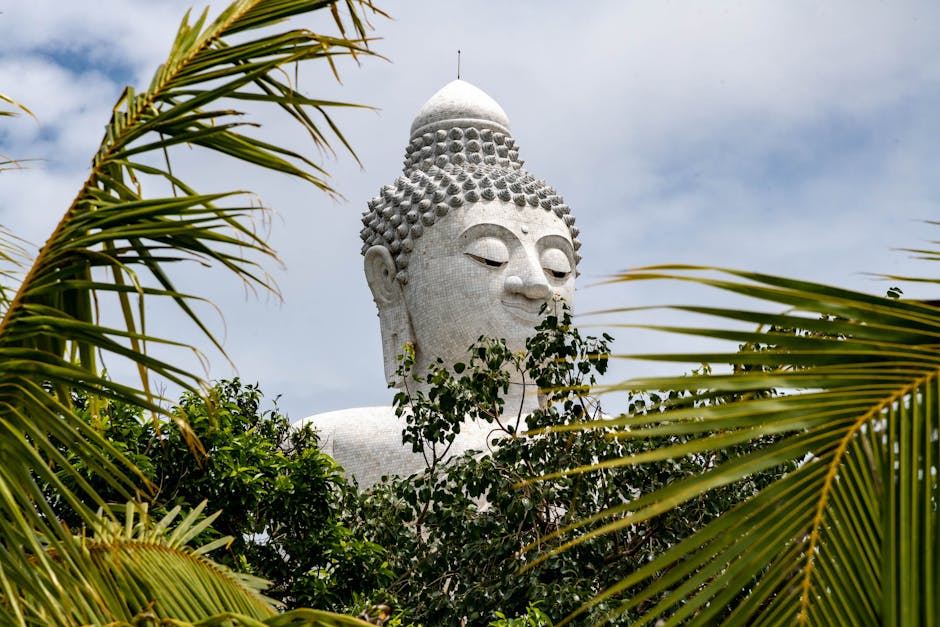
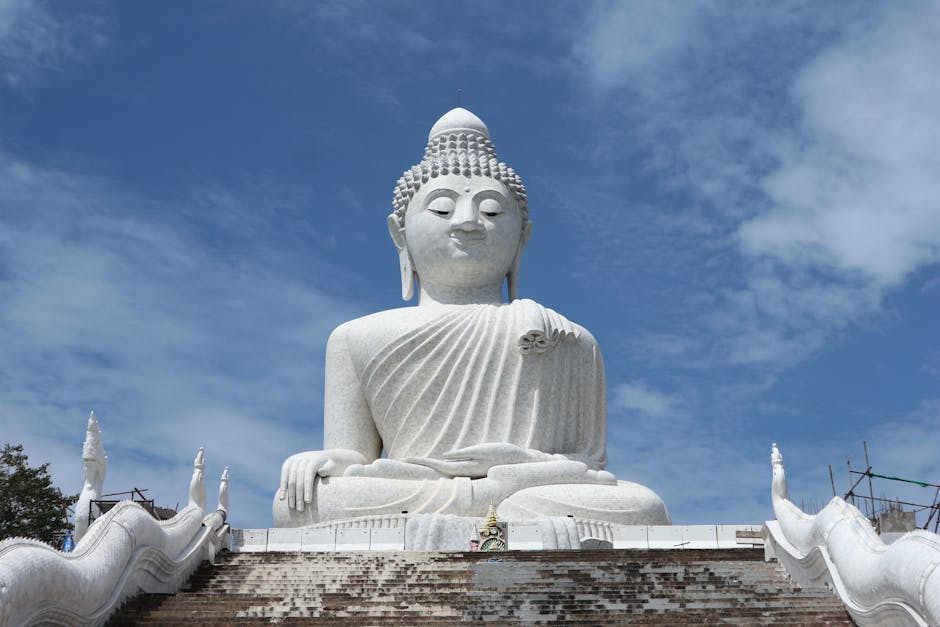
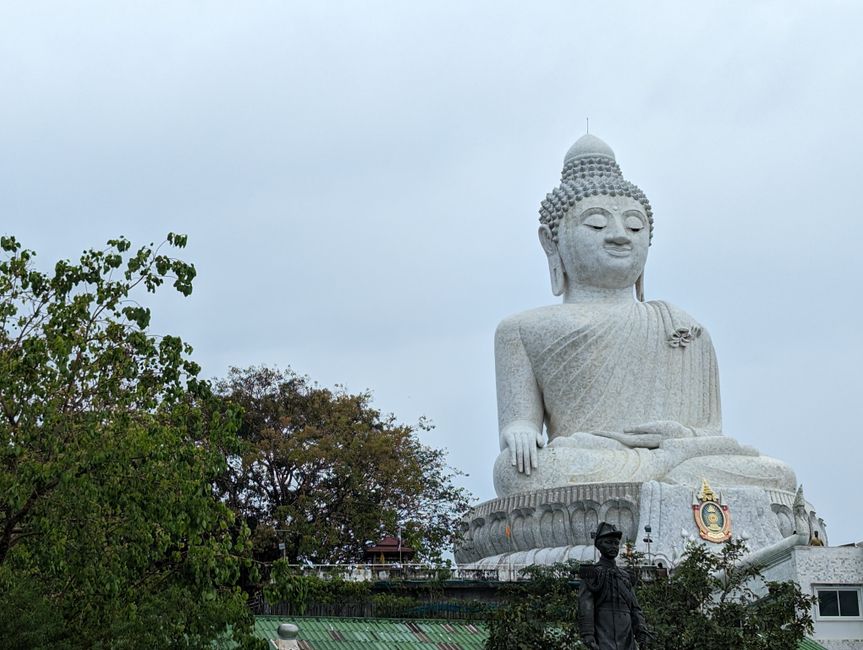
The Phra Puttamingmongkol Akenakkiri Buddha — everyone just calls it the Big Buddha — stands 45 metres tall on the peak of Nakkerd Hill at 381 metres above sea level. Completed in 2002, it’s clad in white Burmese marble and visible from much of the southern half of Phuket on a clear day. The religious significance is real: this is an active place of worship, and the monks and local devotees who come here daily treat it as sacred ground. Visitors are welcome, but the dress code is enforced — shoulders and knees covered. Sarongs are available to borrow at the entrance if you’ve come in beach clothes.
What the photos don’t fully capture is the 360-degree panoramic view. Stand at the viewing platform to the right of the main statue and you’re looking south across Chalong Bay, Rawai, and the offshore islands — Koh Lon, Koh Bon, Koh Hae (Coral Island) — all the way to the hazy outline of Phi Phi on a very clear day. Swing west and you see Kata, Karon, and the long curl of Patong beach. Turn north and the hills of the interior roll toward Thalang. On the eastern side, Phang Nga Bay glitters in the distance.
Local tip: Most tourists spend 20 to 30 minutes here and leave. Spend an hour. Walk the full perimeter of the hilltop. Visit the smaller shrines and spirit houses around the base of the main statue. Climb the steps to the elevated platform. The difference between a rushed visit and a slow one here is enormous.
Bell Towers and the Sound of Merit
One of the most memorable things you can do at the Big Buddha site is walk the row of large ceremonial bells that line the approach path. Visitors make a small donation and strike each bell as they walk — the low, resonant tones echoing across the hilltop feel genuinely spiritual, not touristy. In the early morning, with mist still sitting in the valleys below, this is as close to a meditative experience as you’ll find in Phuket outside of an actual temple.
Eating at the Summit
There are a handful of small food and drink stalls at the top — fresh coconuts, Thai iced coffee, simple snacks. Don’t expect a restaurant. For a proper meal before or after, head back down the hill toward Chalong and look for the cluster of local restaurants around the base of the access road. Roti Chalong, a roadside spot near the Chalong roundabout, does excellent Muslim-style roti with curry — a Phuket institution that costs almost nothing and tastes extraordinary.
-----
The Secret: Phuket’s Hidden Viewpoint
Now this is where the guide gets interesting.
About 90% of visitors to the Big Buddha turn around and go back the way they came. They’ve done the famous thing, they’ve got the photos, they head back to Patong or Kata. What they don’t know — what most travel guides don’t bother to mention — is that the road continues past the Big Buddha parking area, looping around the back side of Nakkerd Hill and eventually connecting to a network of small roads that lead to one of the best viewpoints on the entire island.
I’m not going to name it with a big headline here, because the whole point is that it’s quiet. Locals call it the Khao Mai Kaeo viewpoint area or simply “the back hill road.” It’s a spot known mainly to photographers, motorcyclists, and the occasional expat who’s been on the island long enough to start exploring properly.
How to Find It
From the Big Buddha main parking area, instead of turning back down the access road, look for a smaller road that continues around the eastern side of the hill. This road is unpaved in sections — manageable on a scooter if you’re comfortable, straightforward in a 4WD, and fine in a standard rental car during dry season. During rainy season (May through October), check conditions before you go; parts of this road can get slippery with red clay.
The road winds for approximately 2–3 kilometres, passing through dense forest and occasional clearings before reaching a natural ledge in the hillside. There’s no official car park, no entrance gate, no souvenir stalls. Just a wide spot in the road where several bikes are usually parked, a wooden fence railing, and beyond it, the view.
What you see: The eastern side of Phuket, which almost no tourist ever looks at. Chalong Bay curves below you, the brown-green water of the bay dotted with long-tail boats and the white hulls of dive boats heading out toward the islands. Beyond the bay, the flat land of Mueang Phuket spreads out toward the bridge, and on the clearest days you can see all the way across to the mainland hills of Phang Nga. The light here in the afternoon — especially in the cool-season months from November through February — turns the water into something burnished and golden that you’ll be photographing for an hour without noticing the time pass.
-----
Best Times to Visit Each Spot
Understanding the light and the crowds makes an enormous difference on this route. Here’s how locals time it:
Sunrise run (5:30am – 8:00am)
This is the premium experience if you can get yourself out of bed. Leave Chalong by 5:30am. The road up to the Big Buddha is almost empty in the dark, and reaching the summit just as the sky begins to lighten behind the eastern hills is genuinely spectacular. The statue is illuminated by floodlights at night, and in those transitional minutes between darkness and dawn, it glows against the coral-and-grey sky. By 7am, the light is golden and the photography is perfect. By 8am, the first tour buses start arriving. You’ll already be heading toward the secret viewpoint.
Late afternoon (4:00pm – 6:30pm)
The afternoon is the second-best window. The harsh midday light softens from around 4pm onward, and the western-facing views from the Big Buddha turn extraordinary as the sun moves toward the horizon. The secret viewpoint on the eastern side catches beautiful warm-hour light from roughly 4–5pm before the sun drops too low.
Midday (avoid if possible)
Between 10am and 3pm, the summit is at its most crowded and the light is flat and harsh. If you have no choice but to visit midday, bring sunscreen, hat, and water. The marble reflects heat intensely.
Rainy season notes
The route is doable year-round, but rainy season brings dramatic cloud formations that can actually make the photography more interesting — if you’re lucky, you’ll see the Big Buddha emerging from a sea of low cloud like something from a myth. The unpaved section of road to the secret viewpoint is the main caution. Check recent conditions if visiting June through September.
-----
How to Get There: Renting a Vehicle from Chang Thai Rentals
The honest answer is that this route is best experienced with your own vehicle, specifically a scooter or a small car from a trustworthy rental provider.
Public transport doesn’t reach the Big Buddha directly. Songthaews (red trucks) run fixed routes around Phuket and won’t take you up the hill. Tuk-tuks will take you, but the prices are negotiable in the worst sense — you’ll spend more time haggling than sightseeing. Grab and Bolt operate in Phuket but getting a driver willing to wait at the summit while you explore is unreliable.
Renting from Chang Thai Rentals solves all of this. You leave when you want, you stop when you want, and crucially, you can access the back road to the secret viewpoint — something no tuk-tuk driver is going to take you to unless you specifically know about it and negotiate hard.
Scooter vs. Car for This Route
Scooter (100cc–150cc automatic): The classic Phuket experience. The road up to the Big Buddha is paved and well-maintained, and a standard automatic scooter handles it easily. For the back road section, go slowly and you’ll be fine in dry conditions. The freedom of a scooter — being able to pull over at any viewpoint, feel the wind and the elevation change — makes this the recommended choice for solo travellers and couples who are comfortable riding.
Car (sedan or compact SUV): Better for families or those who aren’t comfortable on a scooter. A compact sedan handles the paved road fine. For the back road to the secret viewpoint, a small SUV with higher clearance is preferable in wet season. The parking at the Big Buddha summit has space for cars.
Chang Thai Rentals provides: Clean vehicles, straightforward pricing, flexible rental periods, and local knowledge. If you ask nicely, the staff can usually tell you current road conditions and any local events that might affect traffic on the route.
-----
The Full Day Itinerary: Doing It Like a Local
If you want to build a full day around this route, here’s how to structure it:
6:00am — Pick up your rental from Chang Thai Rentals. Early pickup means first light at the summit.
6:30am — Arrive at Big Buddha for sunrise. Walk the bell row. Watch the light change. Spend 45–60 minutes here before the crowds arrive.
8:00am — Take the back road to the secret viewpoint. 20–30 minutes exploring, photographing the eastern panorama.
9:00am — Wind back down to Chalong. Stop at Wat Chalong — now open and active but not yet busy with tour groups.
10:30am — Breakfast at one of the local shophouses near the temple. Khao tom (rice porridge), pa-tong-go (fried dough), strong Thai coffee. Total cost: 60–80 baht.
11:30am — Head south toward Rawai for the morning market, or west toward Kata Noi for a beach swim before the midday heat peaks.
2:00pm — Rest period. Every sensible local disappears from the streets between 1–3pm in hot season. Find shade, find air conditioning, find a pool.
4:00pm — If you didn’t catch the afternoon light at the Big Buddha yet, go back now for a completely different experience. Or head to Promthep Cape for Phuket’s famous sunset viewpoint.
6:30pm — Dinner in Chalong. Kanda Bakery for something sweet and air-conditioned, or any of the local restaurants on Wiset Road for proper southern Thai food — massaman, gaeng tai pla, or grilled seafood from the nearby fishing pier.
-----
Practical Information
Address & Navigation
- Big Buddha: Nakkerd Hill, Karon, Mueang Phuket — Google Maps search “Phuket Big Buddha” works reliably
- Chang Thai Rentals: Search “Chang Thai Rentals Phuket” on Google Maps for the current address and to call ahead for vehicle availability
Entrance Fees
The Big Buddha site has no entrance fee. There are donation boxes throughout the complex — contributing 20–100 baht is appropriate and goes toward the temple’s upkeep.
Dress Code
Enforced at the entrance. Shoulders and knees covered. Free sarongs available to borrow. If you’re in beach clothes, no problem — just use the sarong.
What to Bring
- Water (at least one litre per person; the heat at the summit is intense)
- Sunscreen and hat
- Small cash for donations and snacks
- Camera or phone with storage space
- Closed shoes if taking the back road in wet season
Mobile Signal
Strong at the summit. The back road to the secret viewpoint has patchy signal — download offline Google Maps for the area before you leave.
Facilities at Big Buddha
- Public toilets (clean, free)
- Small drink and snack stalls
- Seating areas in the shade
- Information boards in Thai and English
-----
What Makes This Route Special
I’ve lived on this island long enough to take Phuket’s beauty for granted most of the time. The sunsets over the Andaman stop registering at some point. The limestone karsts of Phang Nga Bay become just scenery. This is what happens when you live somewhere extraordinary.
But the route from Chalong up to the Big Buddha and across to that quiet eastern viewpoint still gets me. Maybe it’s because it requires a little effort — you have to climb, you have to navigate a road that isn’t on every tourist map. Or maybe it’s because the combination of religious significance, natural panorama, and genuine local quiet creates something that the beach resorts can’t replicate. You’re not just looking at Phuket from that back-hill viewpoint. You’re seeing the whole sweep of it — the southern tip of Thailand’s largest island laid out like a map, the sea wrapping around it on multiple sides, the hills pushing up through the middle.
That’s the view the locals see. That’s what you’re coming here for.
-----
Final Notes from the Ground
A few things I tell every friend who asks about this route:
Go early. I know I’ve said it already, but I’ll say it again. The difference between arriving at 6am and arriving at 10am is not just the light — it’s the entire atmosphere of the place.
Don’t rush the back road. The secret viewpoint isn’t going anywhere. Take your time on the track, stop if you see a gap in the trees with a view, let your eyes adjust to what you’re looking at.
Bring a local. If you know anyone who lives in Phuket — ask them to come with you. Routes like this are better with someone who can tell you “that cluster of boats is the Chalong dive fleet” or “that island in the distance is Racha Yai.” Context makes landscape.
Come back at a different time of year. Phuket in the cool-season months (November to February) is crisp and clear and the views from the Big Buddha can extend 60 kilometres on a perfect day. Rainy season brings a completely different mood — dramatic, green, brooding. The route is worth experiencing in both.
This is how Phuket is supposed to feel — a little bit of effort, a little bit of local knowledge, and then a view that makes the whole thing worthwhile.
Safe riding, and enjoy the climb.
-----
Planning your trip to Phuket’s Big Buddha and hidden viewpoints? Chang Thai Rentals offers scooter and car hire across Phuket with flexible daily and weekly rates. Visit Chang Thai Rentals to check availability and book your vehicle before you arrive.
Planning a day out? See our Big Buddha, Promthep Cape and Rawai one-day scooter route for the full itinerary.